
How to Experience the BBC Proms for the First Time: A Beginner's Guide to the Royal Albert Hall
Note: This article shares personal opinions and independent research. The BBC Proms programme, ticket prices, and scheduling change annually. Always check the official BBC Proms website before booking or planning your visit. Details reflect information available at the time of writing.
You have heard the name. You have a vague sense that it involves classical music, the Royal Albert Hall, and something about standing. But you have never actually been — and honestly, you are not entirely sure how it works, whether you would enjoy it, or whether you need to remortgage to afford a ticket.
Here is the good news: the BBC Proms is one of the most accessible, affordable, and genuinely thrilling live music experiences in London. And in 2026, with a programme celebrating 250 years of American music, there has never been a better summer to go for the first time.
This is the honest beginner’s guide — no snobbery, no gatekeeping, just everything you actually need to know.
What Are the BBC Proms, Exactly?
The BBC Proms — short for Promenade Concerts — is one of the world’s biggest classical music festivals. It has been running every summer since 1895, making it well over a century old, and it takes place mainly at the Royal Albert Hall in South Kensington.
The 2026 season runs from 17 July to 12 September, with 86 concerts across eight weeks. That is roughly a concert every single night, featuring more than 3,000 musicians from orchestras and ensembles around the world.
The name comes from the tradition of “promming” — standing in the arena or gallery rather than sitting. This is the beating heart of the festival, and it is why, unlike most classical music events, the Proms feels genuinely democratic. You do not need to know anything about classical music to enjoy it. You just need to turn up.
The 2026 Programme: What to Expect This Year
This year’s season is themed around American music, marking 250 years since the US Declaration of Independence. The Met Orchestra makes its Proms debut. The LA Philharmonic returns with Gustavo Dudamel. Martha Argerich and Yuja Wang both perform. World premieres include a new cello concerto by Jessie Montgomery and a concerto for orchestra by Wynton Marsalis.
The First Night opens with the BBC Symphony Orchestra under Dalia Stasevska, beginning with Copland’s Fanfare for the Common Man. The Last Night falls on 12 September, with its traditional mix of pomp, patriotism, and audience singalongs.
But it is not all orchestral. There are jazz Proms (including a Miles Davis centenary concert), family concerts, late-night sessions, and performances at venues outside London too — Bristol, Gateshead, Sunderland, and even Mold in North Wales make the 2026 schedule.
How to Get Tickets (And the £8 Secret)
Here is the part that surprises most first-timers: you can attend a Prom for just £8.
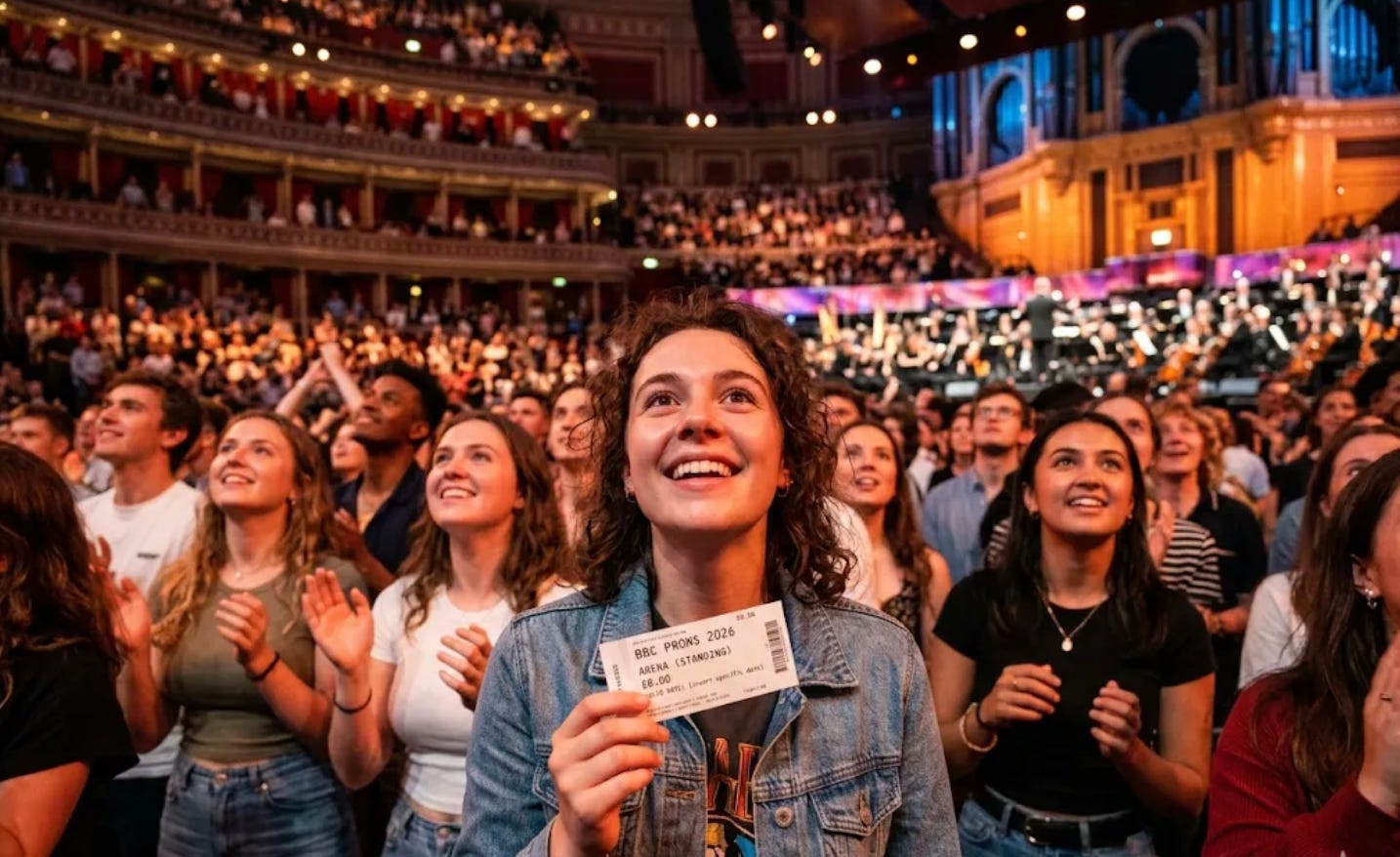
Promming tickets — standing places in the arena (ground floor) or gallery (top level) — cost £8 each. Over 70,000 of these tickets are available across the season, and they are released on the day of each concert. You can buy them online or in person.
Seated tickets are also available and went on general sale on 16 May 2026 via the BBC Proms website. Prices vary by concert, but many seats are still remarkably affordable by London standards.
If there is a specific concert you are desperate to see — particularly the First Night, Last Night, or big-name soloists — book seated tickets early. They sell out. For everything else, promming on the day is perfectly doable and, frankly, the more exciting way to experience it.
What Is Promming Actually Like?
Promming means standing for the duration of the concert — typically around two hours. You are in the arena (surrounding the stage on the ground floor) or up in the gallery (the top tier with its own atmosphere).
The arena is more immersive — you are close to the orchestra, surrounded by sound. The gallery has a bird’s-eye view and its own community of regulars. Both are brilliant.
In my experience, the atmosphere is unlike any other classical music event. There is genuine energy, applause between movements (the Proms audience is forgiving about etiquette), and a feeling that everyone is there because they want to be, not because they are performing sophistication.
Bring a bottle of water. Wear comfortable shoes. Lean against the rail if you need to. It is far less intimidating than it sounds.
Practical Tips for Your First Prom
Getting there: The Royal Albert Hall is in South Kensington. The nearest Tube stations are South Kensington (Piccadilly, Circle, District lines) and Gloucester Road. It is a short walk through beautiful streets — allow ten minutes from the station.
What to wear: Anything you like. Seriously. You will see everything from jeans and trainers to full evening dress. There is no dress code, and the Proms actively encourages newcomers to come as they are.
Arriving: Doors typically open 45 minutes before the concert. If you are promming, arrive earlier for the best standing spots — especially for popular concerts. For regular mid-week Proms, turning up 30 minutes early is usually plenty.
Food and drink: There are bars and food stalls inside the Royal Albert Hall, and the surrounding area has plenty of cafes and restaurants. Kensington is not cheap, but a pre-concert picnic in nearby Hyde Park or Kensington Gardens is a lovely free alternative.
Every concert is broadcast: If you cannot attend in person, every Prom is broadcast live on BBC Radio 3, and 24 concerts are televised on BBC Two, BBC Four, and iPlayer. The full season archive is available on BBC Sounds for up to a year.
The BBC Proms is one of those London experiences that makes you wonder why you waited so long. Eight weeks of world-class music, standing tickets for less than a cinema ticket, and an atmosphere that genuinely welcomes everyone. Whether you go for Copland, for curiosity, or just for a summer evening in one of the most beautiful concert halls in the world — you will not regret it.
FAQs
Q: Do I need to know about classical music to enjoy the Proms?
A: Not at all. The programme notes explain what you are hearing, the atmosphere carries you along, and the BBC Proms website has listening guides for newcomers.
Q: How long is a typical Prom?
A: Most concerts run around two hours, including an interval. Late-night Proms are shorter, usually around 75 minutes.
Q: Can I sit down if I have a promming ticket?
A: There is no seating in the promming areas, but you can sit on the floor during the interval. If standing for two hours is difficult, book a seated ticket instead.
Q: Is the Royal Albert Hall accessible?
A: Yes. The hall has step-free access, wheelchair spaces, accessible toilets, and hearing loops. Check the venue website for full accessibility details.
Q: Can I bring children?
A: Children are welcome at all Proms, and there are dedicated family concerts designed for younger audiences. Under-5s attend free at family Proms.
Q: What is the Last Night of the Proms?
A: The final concert of the season, famous for flag-waving, singalongs, and audience participation. Tickets are allocated partly by ballot. It is broadcast live on BBC television.
Q: Are there Proms outside the Royal Albert Hall?
A: Yes. In 2026, concerts also take place in Bristol, Gateshead, Sunderland, and Mold. Check the programme for details.
Q: Is it worth going midweek?
A: Absolutely. Midweek Proms are often less crowded, and the programme is just as strong. Some of the most adventurous programming happens on quieter nights.
Q: Can I leave during the interval?
A: Yes. You can also arrive for just the second half if the first half does not interest you, though re-entry depends on availability.
Q: How far in advance should I book seated tickets?
A: Popular concerts sell out within days of going on sale. For less well-known programmes, you can often book a few days ahead.
DISCLAIMER
— A note from the editor
Destined for London shares my personal experiences, opinions, and independent research. Everything I write reflects what I’ve found to be true at the time of publishing — but London changes constantly, and what works for me may not work for you. Always do your own research and seek qualified professional advice before making decisions about property, finance, schools, healthcare, or anything else that matters. Some links in my posts are affiliate links, meaning I may earn a small commission at no extra cost to you. Sponsored content is always clearly labelled.