
London Shopping Guide: From High Street to Hidden Independent Boutiques
You’ve arrived in London with a free afternoon and an idea that you’d like to do a bit of shopping. You open Google Maps. Oxford Street appears. You imagine the crowds, the chain stores, the slightly aggressive perfume samples near Boots, and you close the app. There has to be more to it than this.
There is. Considerably more. London is one of the world’s truly great shopping cities — not because of Oxford Street, but because of everything that exists alongside it and beyond it. Markets where traders have been selling vintage clothing since before you were born. Neighbourhood boutiques stocking designers you won’t find anywhere else in Europe. Department stores that are genuinely worth visiting as destinations in their own right. Whether you’re looking for a Portobello Road find, a Liberty print, or a pair of shoes from a Shoreditch independent you’ve never heard of, this guide has you covered.
London’s Shopping Landscape — An Overview
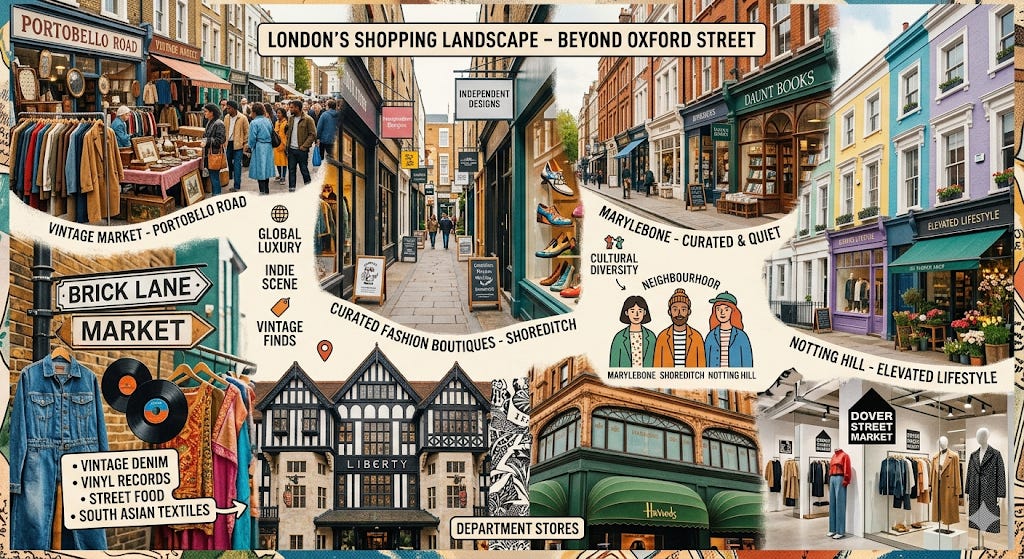
Few cities in the world match London for the sheer variety of its retail. The combination of global luxury, a strong independent scene, brilliant vintage markets, and a high street that actually produces interesting brands makes it genuinely distinctive.
What makes London shopping unique globally
It’s the range. Within a single afternoon you can move from a charity shop stocked with barely-worn designer pieces to a concept store carrying emerging labels to a Georgian market selling Victorian jewellery. The city’s cultural diversity feeds directly into its retail — South Asian textiles in Tooting, West African fabrics in Peckham, Bangladeshi food and homeware on Brick Lane, Japanese and Korean beauty in Soho. You won’t find this cross-cultural richness in Paris or New York, and it makes London’s shopping landscape genuinely one of a kind.
How London’s neighbourhoods each have their own retail personality
Marylebone is curated and calm. Shoreditch is creative and independent. Notting Hill is elevated lifestyle. The City barely shops at all. Knowing which neighbourhood suits your taste saves you enormous amounts of time. This guide takes you through each.
The best time of year to shop
The January sale traditionally kicks off on 27 December, with major department stores and online retailers offering 30–50% reductions on seasonal stock. Summer sales follow in late June and early July. Markets operate year-round but are most enjoyable in spring and autumn — warm enough to browse without rushing, not so hot that the crowds become oppressive.
The High Street — Classics Worth Knowing
London’s high street gets a bad reputation from people who’ve only experienced Oxford Street. The broader picture is considerably more interesting.
Oxford Street: what’s actually worth stopping for
At 1.9 kilometres, it’s exhausting to do end to end. Don’t. Instead, know the specific stops worth making. Selfridges at the western end remains one of the finest department stores in the world — the beauty hall, the food hall, and the fashion floor all deserve time. John Lewis is excellent for homewares, bedding, and reliable mid-range fashion. Primark’s flagship store is genuinely enormous and useful if you need basics quickly. Everything else on Oxford Street, you’ve seen before.
Carnaby Street and the Soho pocket
Two minutes from Oxford Circus, Carnaby Street and its surrounding pedestrianised lanes offer a different experience entirely. Smaller independent brands, footwear boutiques, the odd vintage shop, and the kind of window displays that are actually worth looking at. The area around Broadwick Street, Berwick Street Market (fabrics and flowers on weekdays), and the backstreets of Soho has a character that Oxford Street entirely lacks.
Covent Garden: independent meets mainstream
The cobbled Piazza area splits into the touristy Market Building (good for gifts, prints, and independent accessories) and the surrounding streets, which are genuinely interesting. The Floral Street and Neal Street area has a strong concentration of independent and mid-range fashion. Long Acre connects you northward to more mainstream options. Covent Garden rewards wandering — the streets immediately east and west of the Piazza are better than anything directly inside it.
London’s Market Circuit
Markets are where London shopping genuinely excels. They’re free to browse, accessible by public transport, and often the most entertaining places in the city on a weekend morning.
Portobello Road Market (Saturday vintage)
The antiques section runs from the Notting Hill Gate end of Portobello Road southward, and it’s at its best between 8am and 1pm — after that, many antique stalls pack up. The middle section, around the Westway, transitions into clothing, records, and bric-a-brac. The north end near Golborne Road is more local and less touristy — excellent for furniture, vintage ceramics, and the occasional extraordinary find. Arrive hungry: the street food in the middle section is genuinely good. Take the Circle or Central line to Notting Hill Gate or Holland Park.
Brick Lane Market (Sunday, East London)
The market itself runs from around 9am to 5pm and fans out across Brick Lane, Sclater Street, and the surrounding streets. Vintage clothing, furniture, art prints, street food, and a general Sunday-in-East-London atmosphere. The Truman Brewery complex hosts a curated vintage market inside that’s worth the entry fee. The surrounding area — Spitalfields, Shoreditch — has permanent vintage and independent shops that are open daily. Shoreditch High Street Overground gives you direct access.
Borough Market, Columbia Road, and the food-meets-shopping experience
Borough Market (Thursday to Saturday, London Bridge) is primarily food, but the area around it — Bermondsey Street, Maltby Street — has become one of London’s most interesting retail pockets for ceramics, design, and independent fashion. Columbia Road Flower Market (Sunday mornings, Bethnal Green) is officially a flower market but the surrounding shops — independent jewellers, vintage homeware, print sellers — make it a full shopping experience. Go before 10am for the best flowers; stay for the shops and the neighbourhood cafés afterward.
Independent Boutiques by Neighbourhood
The best independent shopping in London happens at neighbourhood level. Here’s where to go by taste.
Marylebone High Street — curated and quiet
The most pleasant high street in London that nobody outside London seems to know about. A single pedestrian-friendly street with an excellent edit of independents — fashion boutiques, bookshops, delis, kitchen shops, and the wonderful Daunt Books flagship, which is as much a visit as a shop. The nearby Chiltern Street adds further options, including the Monocle shop and a cluster of thoughtful independent retailers. Central or Bakerloo line to Baker Street.
Shoreditch and Spitalfields — creative and independent
Brick Lane and the surrounding streets are where London’s creative independent scene lives. Sun Jellies on Bethnal Green Road for colourful footwear, Present London on Shoreditch High Street for curated menswear, and dozens of smaller boutiques selling independent jewellery, prints, and clothing. Spitalfields Market itself has permanent indoor stalls that include independent fashion and homeware alongside food. The energy here is genuinely creative, and you’re as likely to discover a brand you’ve never heard of as to find something familiar.
Notting Hill and Westbourne Grove — elevated lifestyle
Westbourne Grove is London’s most understated luxury shopping street — the kind of boutiques that don’t feel the need to shout. A concentration of well-chosen lifestyle shops sit alongside excellent delis and cafés. Ledbury Road, running off Westbourne Grove, has a beautiful cluster of independent clothing and homeware boutiques. This is elevated shopping done quietly and well.
Luxury and Department Store Shopping
London’s top-end retail is genuinely world-class, and several of the flagship stores are worth visiting regardless of whether you’re planning to buy.
Selfridges, Liberty, and Fortnum & Mason
Selfridges on Oxford Street is the city’s most democratic luxury retailer — accessible enough that anyone feels welcome, curated enough that the choices are excellent. The beauty hall and food hall alone justify the visit. Liberty on Great Marlborough Street is one of London’s most beautiful buildings (a mock-Tudor mansion built from old ship timbers) and one of its most distinctive retailers — famous for its prints, its fashion edit, and its homeware floor. Fortnum & Mason on Piccadilly is the gift-buyer’s paradise: extraordinary food halls, exceptional teas, and packaging that makes everything feel like a present.
Knightsbridge: Harrods and Harvey Nichols
Harrods is a tourist attraction as much as a shop, and honestly, it’s worth experiencing once — the food halls on the lower ground floor are extraordinary. Harvey Nichols, diagonally opposite, is more focused as a fashion retailer and has a superb beauty floor. The surrounding streets of Sloane Street are home to virtually every luxury fashion house in London.
Dover Street Market — for the fashion-forward
Located on Haymarket, Dover Street Market is the concept store that every other concept store aspires to be. Six floors of international fashion — Comme des Garçons, Gucci, Sacai, Marine Serre — arranged with the aesthetic precision of a gallery installation. Even if you’re not in the market for anything it stocks, it’s one of the most interesting visual experiences London retail has to offer. Open Monday to Saturday.
London’s best shopping doesn’t announce itself. It’s down a side street in Marylebone, in a stall at Portobello before the crowds arrive, in a Shoreditch boutique run by a designer who started with a market pitch. The city rewards the shopper who wanders, explores, and resists the pull of the obvious.
Start with one neighbourhood, one market, or one department store. See where it takes you. London has enough layers to keep any curious shopper busy for years — and the best finds are always the ones you weren’t looking for.
FAQs
Q: What’s the best area for shopping in London for first-time visitors?
A: Start with Covent Garden for a mix of mainstream and independent options in a beautiful setting. Add a Saturday morning at Portobello Road or a Sunday at Brick Lane if you’re interested in vintage.
Q: Is shopping in London expensive?
A: It ranges enormously. Brick Lane and charity shops in wealthier neighbourhoods can yield brilliant finds for under £20. Oxford Street high street is comparable to other major cities. Knightsbridge and Mayfair are genuinely expensive. Budget by neighbourhood and you’ll navigate it well.
Q: Are London’s charity shops worth visiting?
A: Absolutely — particularly in wealthier areas. Chelsea, Notting Hill, and Wimbledon charity shops regularly receive barely-worn high-end pieces. The Oxfam on King’s Road and various shops on Fulham Road are known among Londoners for yielding surprising finds.
Q: Is Portobello Road Market open every day?
A: Portobello Road has market activity most days, but the famous antiques section only operates fully on Saturdays. Arrive before 1pm for the best selection from antique dealers.
Q: What time does Brick Lane Market start?
A: From around 9am on Sundays, with the best atmosphere and selection between 10am and 2pm. Arrive early for first pick of vintage clothing and to avoid the largest crowds.
Q: Is it worth visiting Harrods or just a tourist trap?
A: Worth visiting at least once for the food halls and the sheer experience, but it’s expensive and very tourist-heavy. Harvey Nichols, a short walk away, offers a better focused luxury shopping experience.
Q: Where can I find independent London fashion brands?
A: Shoreditch and Spitalfields are the best starting points. The area around Brick Lane, Redchurch Street, and Shoreditch High Street has the highest concentration of genuinely independent fashion labels in the city.
Q: What’s Carnaby Street like now?
A: It’s largely pedestrianised and has a strong selection of mid-range and independent footwear and clothing brands, with less of the tourist-trap feel than neighbouring Oxford Street. Worth an hour of your time.
Q: Where do London locals actually shop?
A: Depends on the neighbourhood. East Londoners shop Brick Lane for vintage and Spitalfields for independent brands. West Londoners favour Portobello Road and Westbourne Grove. Marylebone residents treasure their high street. Nobody goes to Oxford Street if they can avoid it.
Q: Are London’s markets cash-only?
A: Increasingly, no. Most market traders now accept contactless card payment, particularly in popular areas like Portobello and Brick Lane. Bring some cash as a backup, as smaller stalls may still prefer it.
DISCLAIMER
— A note from the editor
Destined for London shares my personal experiences, opinions, and independent research. Everything I write reflects what I’ve found to be true at the time of publishing — but London changes constantly, and what works for me may not work for you. Always do your own research and seek qualified professional advice before making decisions about property, finance, schools, healthcare, or anything else that matters. Some links in my posts are affiliate links, meaning I may earn a small commission at no extra cost to you. Sponsored content is always clearly labelled.