
London's Best-Kept Secrets: Gorgeous Spots That Don't Make the Guide Books
London is 607 square miles of city and has been accumulating interesting things for two thousand years. The idea that any guide can document all of it is obviously false — and the spots that don’t make the guides are often the most interesting.
Here are the places that locals know and visitors rarely find.
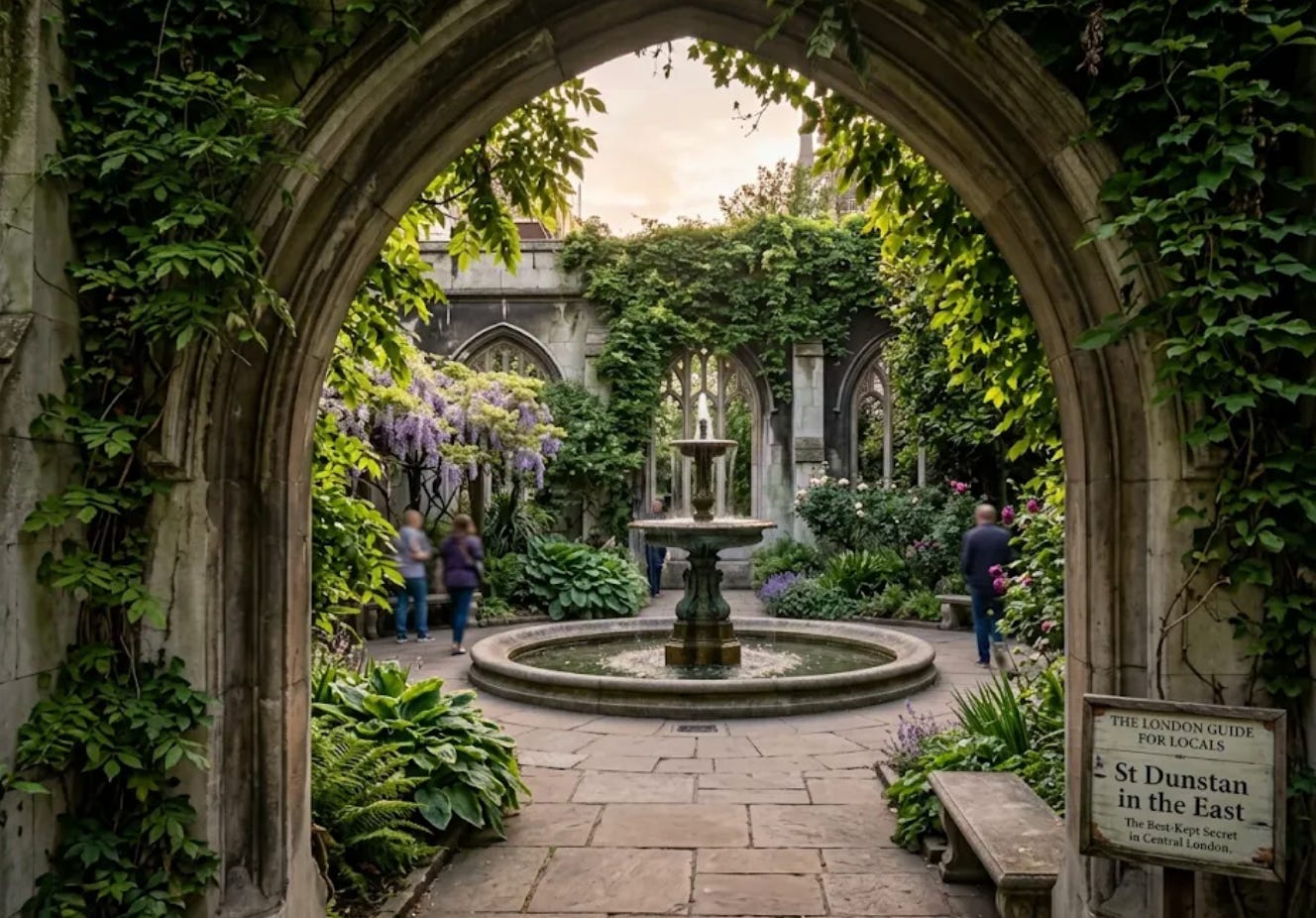
St Dunstan in the East
A Wren church in the City of London, bombed in the Blitz and never rebuilt. The roofless shell has been planted as a public garden — climbing plants up the Gothic arches, an open sky above, a working fountain at the centre. It’s free, open daily, and almost always quiet.
This is, in my opinion, the single best-kept secret in central London. It’s two minutes from Monument tube, metres from busy streets, and almost entirely invisible until you step through the gate.
The Ely Place and the Ye Olde Mitre Pub, Holborn
Ely Place is a private road off Holborn Circus — it has its own beadle and gates, and was historically the property of the Bishops of Ely rather than the City of London. The Tudor gatehouse is still standing. At the far end of the alley beside the gatehouse is Ye Olde Mitre, a pub dating to 1546 (the current building is 18th century) hidden in a narrow passage and serving genuinely excellent traditional pub food.
It’s one of the most atmospheric pubs in London and the most difficult to find without knowing about it. When you arrive, there are few things more pleasantly disorienting than an apparently hidden Tudor pub at the end of a private lane in Holborn.
Getting there: Chancery Lane tube, then a short walk to Ely Place.
The Pergola and Hill Garden, Hampstead
At the top of the West Heath in Hampstead is an Edwardian pergola — a formal walkway of stone columns covered in old climbing plants, with views over the Heath to the south. It’s part of the Hill Garden, designed for Lord Leverhulme in the 1920s. Genuinely extraordinary in late spring when the wisteria and roses are in bloom.
Free to visit. Extremely easy to miss even if you know it’s there. Walk north through the West Heath from Hampstead tube.
The Wellcome Collection, Euston Road
The Wellcome Collection is a free museum dedicated to the intersection of medicine, science, and culture. The permanent collection — assembled by pharmaceutical magnate Henry Wellcome in the late 19th and early 20th centuries — includes medical instruments, artworks, specimens, and curiosities that add up to something genuinely thought-provoking.
The temporary exhibitions are consistently excellent. The building is beautiful. It’s on the Euston Road (a few stops from King’s Cross on the Overground) and is almost entirely overlooked compared to the South Kensington museums.
The Electric Cinema, Notting Hill
The Electric Cinema on Portobello Road opened in 1910, making it one of the oldest working cinemas in Britain. The interior has leather armchairs, footstools, and a bar — watching a film here is a genuinely different experience from a multiplex. Tickets are more expensive than a standard cinema, but the experience is worth it once.
At the time of writing, the Electric operates as a member and non-member cinema. Check the website for current programming and pricing.
The Geffrye Museum (Now the Museum of the Home), Shoreditch
The Museum of the Home (renamed from the Geffrye Museum) in Shoreditch presents the history of English domestic interiors through a series of period rooms from the 1630s to the present day. It’s free, it’s fascinating, and it’s consistently overlooked in favour of the trendier Shoreditch venues nearby.
The almshouse buildings the museum is housed in are extraordinary in their own right — a row of 18th-century brick almshouses with a central chapel.
The Barbican Conservatory
One of the largest conservatories in London, housed inside the Barbican arts complex, is open to the public on certain Sundays and bank holidays. Tropical plants, finches flying freely, fish ponds. It’s free (check for donations) and entirely at odds with the brutalist concrete exterior of the Barbican building.
At the time of writing, opening is limited to specific Sundays and holidays — check the Barbican website.
FAQs
1. Is St Dunstan in the East really always open?
At the time of writing, yes — it’s a City of London public garden open daily during daylight hours. Check for temporary closures.
2. How do I find Ye Olde Mitre Pub?
From Ely Place (off Holborn Circus), look for the narrow passage to the left of the gatehouse. The pub is at the end of the passage. If you walk past a beadle’s gatehouse, you’re in the right place.
3. Is the Wellcome Collection really free?
Yes — the permanent collection is free. Some special events may be ticketed.
4. Can I visit the Barbican Conservatory without going to an event?
Yes — on designated open Sundays and holidays. Check the Barbican website for dates, as these are limited.
5. Is the Pergola in Hampstead accessible?
The Heath has uneven terrain, and the Pergola involves some uphill walking. Partially accessible but not fully.
6. What is the Museum of the Home’s address?
Kingsland Road, Shoreditch, E2 8EA. Overground to Hoxton, a short walk.
7. Is the Electric Cinema expensive?
More expensive than a standard cinema — tickets run around £15–25 depending on seat type. The experience justifies a one-time visit, in my opinion.
8. Are these places suitable for children?
St Dunstan in the East (garden, good for children), the Wellcome Collection (depends on age — some content is adult-oriented), and the Barbican Conservatory (plants and fish, universally engaging). The others are primarily adult.
9. How do I get to the Museum of the Home?
Overground to Hoxton (a few minutes from Shoreditch High Street). The museum is on Kingsland Road.
10. What’s the most extraordinary thing on this list?
St Dunstan in the East, in my experience, not for historical or architectural importance, but for the feeling of stepping through a gate in a busy city street and finding something completely, quietly extraordinary on the other side.
— A note from the editor
Destined for London shares my personal experiences, opinions, and independent research. Everything I write reflects what I’ve found to be true at the time of publishing — but London changes constantly, and what works for me may not work for you. Always do your own research and seek qualified professional advice before making decisions about property, finance, schools, healthcare, or anything else that matters. Some links in my posts are affiliate links, meaning I may earn a small commission at no extra cost to you. Sponsored content is always clearly labelled. Read the full Terms and Privacy Policy.