
London's Best Korean BBQ and Japanese Omakase: The 2026 Dining Guide
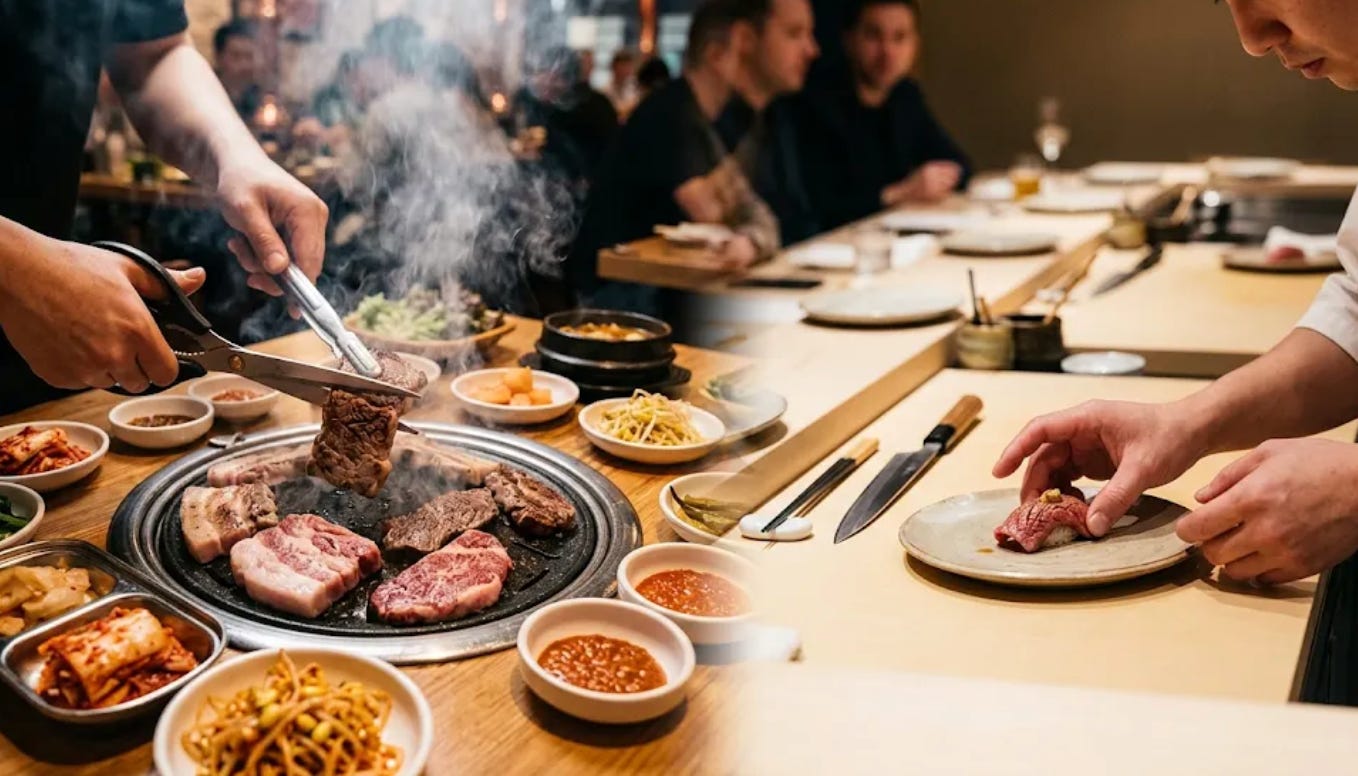
There’s a moment at a proper Korean BBQ when the meat hits the tabletop grill, the fat starts to render, and the sound and smell are both so immediate that the rest of the restaurant just disappears. You’re just here, with the smoke and the scissors and the banchan, and the whole thing is completely alive.
Korean BBQ has been one of London’s favourite dining experiences for years. But 2026 has brought something different: not just good Korean BBQ, but elite Korean BBQ. Restaurant groups from Seoul are arriving with serious intent. And alongside them, Japanese omakase — the chef-led tasting format where you eat what they give you and trust the process — is finding its deepest London expression yet.
These are two very different dining experiences, united by a shared philosophy: that the best food involves the cook, not just the menu. Whether you’re sitting at a counter watching a sushi master work with extraordinary precision, or managing four different proteins on a tabletop grill, there’s an attention and presence required that most London restaurants simply don’t ask for.
This guide covers what’s new, what’s great, and what to expect at the table.
The Korean BBQ Boom: What’s New in 2026
Korean food in London has never had more energy than it does right now, and the arrival of Kiji at 60 Curzon Street in Mayfair is the clearest signal of where things are heading.
Kiji is the London debut of Ellia and Junghyun Park, whose New York restaurant Atomix consistently ranks at the top of North America’s best restaurant lists. That pedigree matters enormously. The Park team brings an elevated Korean BBQ format to London — premium cuts, an exceptional drinks programme, and the kind of service that makes a meal feel like an event. The Curzon Street site has just been redeveloped, and the setting is genuinely striking.
The arrival of a team like this signals that London has been taken seriously as a market for Korean fine dining. For years, the best Korean food in London lived in New Malden (the centre of London’s Korean community) and scattered through Soho and Covent Garden. The genre is now reaching into Mayfair in a way that suggests genuine ambition rather than market-filling.
Beyond Kiji, the established scene remains strong. The Korean restaurants of New Malden — particularly around the High Street — remain the best value Korean food in London and well worth the journey (a direct train from Waterloo) if you want the real thing without the premium prices.
Japanese Omakase: London’s Best in 2026
Omakase — the Japanese dining format where the chef chooses your meal — has been gaining ground in London for years. In 2026, the options are better than they’ve ever been, spanning from the extraordinary to the surprisingly accessible.
MA/NA in Mayfair is the new headline opening. From the Thesleff Group (the team behind Endo at the Rotunda), it’s a 156-cover restaurant celebrating the craft of Japanese food. Chef Leo Tanyag’s menu includes M5 Wagyu seared on a Himalayan salt stone and a strong sushi programme. This is London’s most anticipated Japanese opening right now, and early interest confirms the ambition is matched by execution.
For sushi specifically, Endo at the Rotunda in White City remains one of London’s finest experiences — a counter facing the chef, courses of exceptional nigiri, and a room with views across West London. Expensive, yes, but genuinely extraordinary.
The Azuki in Chancery Lane is the more accessible end of the spectrum — from the owner of the popular Dotori restaurant, it promises to blend Japanese cuisine with the energy of a Tokyo backstreet izakaya. This is the antidote to formal tasting menus: intimate, personality-led, and designed for people who want the quality without the stuffiness.
Kumori has relocated from Brixton to a new two-level space on Maddox Street in Mayfair. The handroll format — simpler than full omakase but with similar attention to sourcing and technique — makes it one of the most approachable high-quality Japanese dining experiences in the city. Sixteen counter seats, twenty-eight covers above, inspired by Japanese listening bars. Worth the reservation.
What to Know Before You Go
Both Korean BBQ and Japanese omakase reward a little preparation.
For Korean BBQ, let the staff manage the grill if they offer to — in the better restaurants, they will. Don’t rush the banchan (the small side dishes are there to be eaten throughout, not cleared). Order more than you think you need; the experience is social and works best with three or four people.
For Japanese omakase, the key is trust. You are putting yourself in the chef’s hands entirely. Dietary restrictions should be communicated well in advance — not the day of, not during the meal. The counter is the best seat: you can watch the preparation, ask questions in the more relaxed formats, and understand what you’re eating.
On booking: both formats require forward planning in 2026. For Kiji and MA/NA, reservations are essential. For omakase counter seats, expect to book six to eight weeks ahead for the most sought-after spots.
Best Value Options
Not every meal needs to be a Mayfair event.
For Korean BBQ, New Malden in Surrey (on the train from Waterloo) is the answer. The Korean community there is London’s largest, and restaurants serve excellent, generous food at a fraction of central London prices. It’s a genuinely brilliant evening out for anyone who hasn’t made the trip.
For Japanese at a mid-price point, the lunch menus at quality Japanese restaurants across London offer the same sourcing and technique at more accessible price points. Standing sushi bars near Borough Market and in Soho offer real quality without the booking anxiety.
London’s Korean BBQ and Japanese omakase scenes are doing what London’s food world does at its best: taking influences seriously, elevating them, and making them available to a city that’s ready to receive them.
Whether you’re looking for an elevated Mayfair dinner or an evening in New Malden’s best Korean kitchen, the options in 2026 are better than they’ve ever been. Book early, eat slowly, and enjoy every single piece.
FAQs
Q: What is omakase dining?
A: Omakase is a Japanese dining format meaning “I’ll leave it to you.” The chef designs the meal based on the best seasonal ingredients available that day. You typically don’t see a menu — you eat what you’re served, with the number of courses and specific dishes decided by the kitchen.
Q: How much does omakase dining cost in London?
A: Entry-level omakase experiences start from around £80–£120 per person at lunch. High-end counter experiences — like Endo at the Rotunda — can reach £250–£400+ per person before drinks. MA/NA in Mayfair is expected to sit in the premium tier.
Q: Is Korean BBQ good for vegetarians?
A: Many Korean restaurants offer vegetable and tofu grill options, and banchan (side dishes) are often vegetarian or vegan. It’s worth calling ahead or checking menus in advance, as the quality of the vegetarian offering varies between restaurants.
Q: Where is the best Korean BBQ in London for a special occasion?
A: Kiji at 60 Curzon in Mayfair is currently the most elevated Korean BBQ experience in London. For a brilliant, more casual special occasion meal, the better restaurants in New Malden offer extraordinary value and authenticity.
Q: What does MA/NA cost?
A: MA/NA’s full pricing was not publicly confirmed at time of writing. Given its Mayfair setting and the Thesleff Group’s track record, expect fine dining pricing — likely £150–£250+ per person including drinks.
Q: What is a handroll restaurant?
A: A handroll restaurant — like Kumori — serves temaki: nori cones filled with rice, fish, and other ingredients, freshly rolled and served immediately. The format is more casual than traditional omakase but requires similar skill and quality in sourcing.
Q: Do I need to speak Japanese to enjoy omakase dining in London?
A: Not at all. Most London omakase restaurants have English-speaking chefs and staff, and the experience is designed to be fully accessible to diners unfamiliar with Japanese dining culture.
Q: What is the best area of London for Korean food?
A: New Malden in Surrey (on the train from Waterloo) is the heart of London’s Korean community and has the highest concentration of authentic Korean restaurants at the best prices. For central London, Soho and Covent Garden have the most options.
Q: How far in advance do I need to book top Korean BBQ and omakase restaurants?
A: For the most popular venues — Kiji, MA/NA, Endo at the Rotunda — booking six to eight weeks in advance is advisable. Smaller or newer venues may be more available at shorter notice.
Q: Is London’s Japanese dining scene improving?
A: Yes, significantly. The quality of omakase experiences, sourcing of Japanese ingredients, and arrival of internationally acclaimed chefs over the past three years have made London’s Japanese dining scene genuinely world-class.
DISCLAIMER
— A note from the editor
Destined for London shares my personal experiences, opinions, and independent research. Everything I write reflects what I’ve found to be true at the time of publishing — but London changes constantly, and what works for me may not work for you. Always do your own research and seek qualified professional advice before making decisions about property, finance, schools, healthcare, or anything else that matters. Some links in my posts are affiliate links, meaning I may earn a small commission at no extra cost to you. Sponsored content is always clearly labelled.