
The British Museum, the Natural History Museum, the V&A — everyone knows about these. They’re extraordinary and fully deserve their reputations. But London has dozens of smaller, more specific, more unusual museums that most visitors never reach — and some of them are among the most interesting institutions in the city.
Here are the ones worth seeking out.
The Wellcome Collection, Euston Road
Free. One of the most thought-provoking museums in London, covering the intersection of medicine, science, and human culture. The permanent collection includes medical instruments, artworks, specimens, and historical artefacts that add up to something genuinely unusual.
The temporary exhibitions at the Wellcome are consistently excellent — often better, in terms of intellectual depth and curatorial ambition, than exhibitions at the more famous institutions. The building is beautiful, with a library and reading room that are open to visitors.
Getting there: Euston or Euston Square tube.
The Horniman Museum, Forest Hill
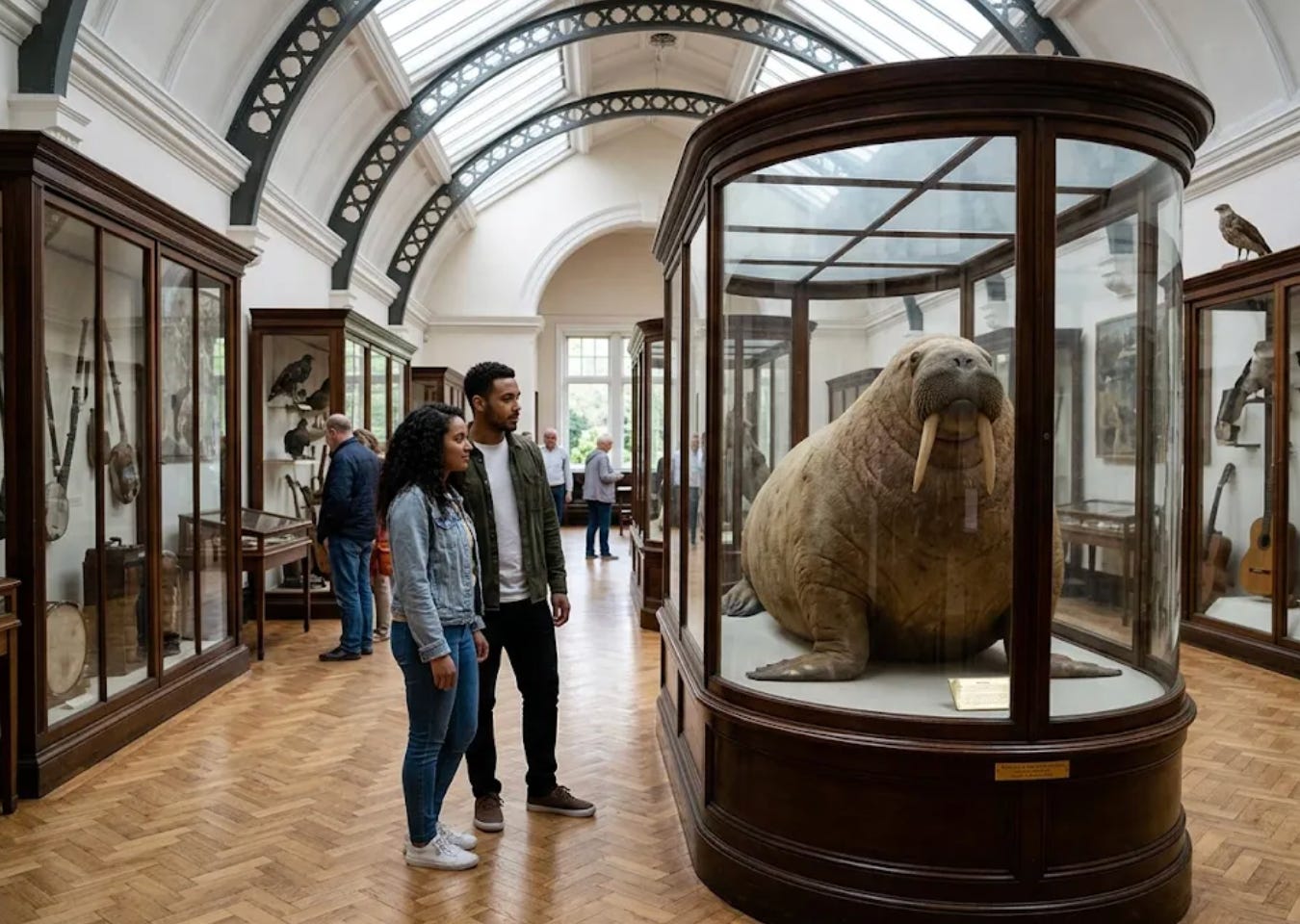
Free, in a Victorian building in Forest Hill, south London. The Horniman was assembled by Frederick Horniman — a Victorian tea merchant — who collected objects from across the world on his travels. The collection includes natural history specimens, musical instruments from around the world, and anthropological material from dozens of cultures.
The walrus in the natural history hall is famous: Horniman’s taxidermist had never seen a live walrus and so stuffed the skin to the point of complete roundness, producing one of the most comically over-stuffed animals in any museum. The gardens are excellent and free.
Getting there: Forest Hill station (trains from London Bridge or Victoria).
The Museum of the Home (Formerly Geffrye Museum), Shoreditch
Free. A museum of English domestic life, housed in 18th-century almshouses in Shoreditch. The collection presents the history of the English home from the 1630s to the present through a series of period room interiors. It’s a quiet, thoughtful museum that most visitors to Shoreditch walk straight past.
The almshouse buildings and garden are beautiful. The 20th-century rooms — 1930s kitchen, 1970s sitting room — are particularly good.
Getting there: Hoxton Overground.
The Museum of London (Now Museum of London Docklands)
The Museum of London has been rehoused in recent years. The Museum of London Docklands at West India Quay is free and covers the history of London’s river, trade, empire, and the slave trade with unusual directness and historical honesty.
The building — a converted Georgian warehouse in Canary Wharf — is extraordinary, and the exhibition on London’s role in the transatlantic slave trade is one of the most important in the country.
Getting there: West India Quay DLR.
The Dulwich Picture Gallery, South London
The world’s first public art gallery, designed by John Soane in 1811, Dulwich holds an exceptional collection of Old Masters — Rembrandt, Rubens, Poussin, Gainsborough — in a purpose-built gallery that is itself a work of architectural art.
Entry around £14 for adults, free on Fridays for local residents. South London, about 20 minutes from London Bridge by train. One of the most beautiful art experiences in the city.
Getting there: West Dulwich station (trains from Victoria), a short walk.
The Two Temple Place, Embankment
An extraordinary neo-Gothic mansion built for the Astor family in 1895, now used as an exhibition space open for free (during exhibitions) in winter and spring. The building itself — carved mahogany staircase, gold leaf, stained glass, extraordinary craftsmanship — is arguably better than any exhibition it hosts.
At the time of writing, Two Temple Place is open during its annual exhibition season (usually January through April). Check the website for current programming.
The Foundling Museum, Bloomsbury
The Foundling Hospital was England’s first children’s charity, established by Thomas Coram in 1739 to care for abandoned children. The museum — housed in an 18th-century building in Bloomsbury — tells this story through artworks, historical documents, and objects.
The collection includes Hogarth paintings, Handel manuscripts (the Foundling Hospital was a significant patron of his music), and the original tokens left by mothers who abandoned children with the hospital, hoping one day to reclaim them. Entry around £11.
Getting there: Russell Square tube.
FAQs
1. Why are these museums less well-known?
In my experience, a combination of location (several are outside Zone 1), subject matter (more specialised than the broad national collections), and simply the dominance of the major museums in travel guides and recommendations.
2. Are these museums free?
The Wellcome Collection, Museum of the Home, and Museum of London Docklands are free. The Dulwich Picture Gallery, Foundling Museum, and Two Temple Place (during exhibitions) charge varying amounts.
3. Is the Horniman Museum really worth the journey to Forest Hill?
In my opinion, yes — particularly for families (children respond extraordinarily well to the overstuffed walrus and the musical instruments collection) and for anyone interested in ethnography and natural history.
4. How do I get to Forest Hill?
Train from London Bridge or Victoria to Forest Hill station — about 20 minutes. The museum is a short walk from the station.
5. Is Two Temple Place always open?
No — it’s open for a specific exhibition season each year, typically January through April. Check the website before visiting.
6. What makes the Dulwich Picture Gallery special?
The quality of the collection, the beauty of the Soane-designed building, and the consistently low visitor numbers compared to central London equivalents. In my experience, you can stand in front of a Rembrandt here with almost no one else in the room.
7. Is the Wellcome Collection suitable for children?
Older children and teenagers, yes — in my experience it generates genuine curiosity and discussion. Some content is medically graphic, which parents should be aware of.
8. Are any of these museums accessible?
The Wellcome Collection, Museum of London Docklands, and Museum of the Home are fully accessible. The Dulwich Picture Gallery and Horniman Museum have good accessibility. Two Temple Place has limited accessibility due to its historic staircase.
9. What is the best museum for someone interested in London’s history?
The Museum of London Docklands for honest, well-curated coverage of the city’s history including the difficult parts. The Museum of the Home for domestic and social history.
10. Which museum on this list is most worth making a special trip to?
In my opinion, the Horniman Museum — the combination of the collection, the building, the garden, and the sheer unexpectedness of finding it in Forest Hill makes it one of the most genuinely surprising museum experiences in London.
— A note from the editor
Destined for London shares my personal experiences, opinions, and independent research. Everything I write reflects what I’ve found to be true at the time of publishing — but London changes constantly, and what works for me may not work for you. Always do your own research and seek qualified professional advice before making decisions about property, finance, schools, healthcare, or anything else that matters. Some links in my posts are affiliate links, meaning I may earn a small commission at no extra cost to you. Sponsored content is always clearly labelled. Read the full Terms and Privacy Policy.