
Queen's Park, Dalston, Hackney: The London Neighbourhoods You Need to Explore This Year
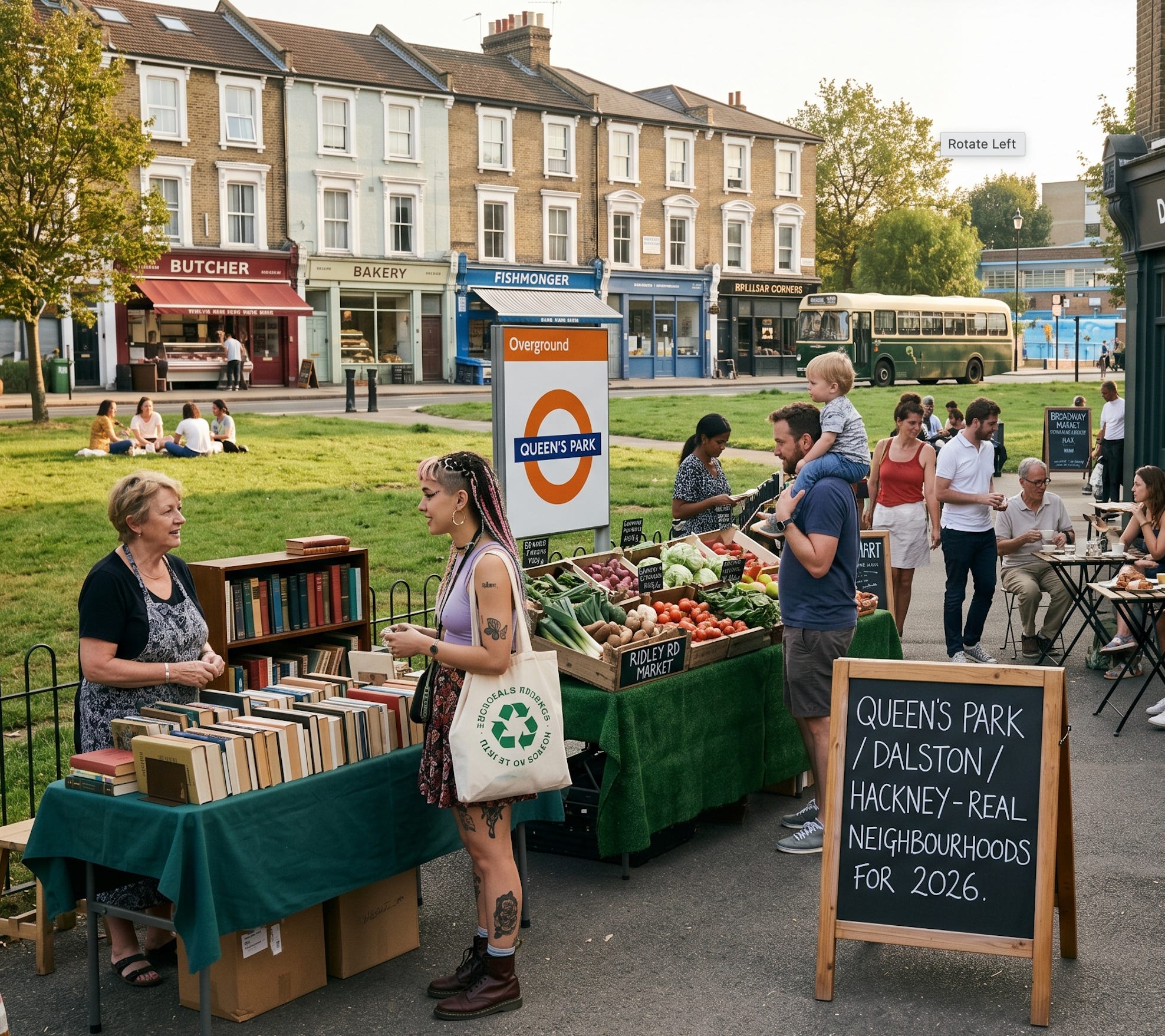
There’s a particular moment when you stop being a tourist in a city and start being someone who actually lives there. You find a coffee shop where the barista knows your name. You develop opinions about which Overground station is best. You discover neighbourhood secrets that don’t appear in any guidebook.
For 2026, three London neighbourhoods are quietly becoming essential. Not because they’ve just been “discovered” — London moves faster than that — but because they’ve reached a point where the food is genuinely excellent, the character is still intact, and you can actually afford to be there.
Queen’s Park: The Village That Isn’t
Queen’s Park is what happens when you take a Victorian village, move it into Zone 2, and add excellent cocktails.
The neighbourhood sits along the Bakerloo line in northwest London, and it has developed a reputation as quietly becoming the place to be in 2026. It feels different from most London areas — it has the charm of somewhere that hasn’t tried too hard to be cool, which is precisely why it is.
Salusbury Road is the heart of it. Independent shops line the street: a beloved butcher, a fishmonger, cafés, vintage furniture stores. It feels like how London probably used to feel before everything became a chain. The shops actually close on Sundays. People actually know each other. It’s possible to walk the same streets and see new things.
Don’t Tell Dad is the spot for drinks. Cocktails that are actually delicious (not Instagram-bait), small plates that feel like you’re eating at someone’s dinner party, interiors that are thoughtful without being precious. It’s the kind of place where locals go and don’t mind when friends ask for recommendations.
Queen’s Park itself — the actual park — is 12 hectares of green space with a proper café, children’s play area, and tennis courts. On sunny weekends, it’s where the neighbourhood gathers. Not rammed. Not quiet either. Just genuinely nice.
The housing stock is mostly Victorian terraces, and rents are reasonable by London standards — notably more affordable than equivalent West London neighbourhoods. The community feels intergenerational: young families, long-term residents, creative types, people who chose to be here rather than landed here by accident.
It suits people who want to feel London without the relentless hype. Who want good independent shops and decent food and space to breathe. Who appreciate that this neighbourhood has personality precisely because it’s not trying to perform for an audience.
The transport is straightforward — Bakerloo line gets you to central London in about 15 minutes — but what’s interesting is that people don’t seem to spend much time in the centre. They stay local.
Dalston: The Polyglot’s Neighbourhood
Dalston is where you go to eat properly.
The Overground stations — Dalston Junction and Dalston Kingsland — provide excellent connectivity east, and the neighbourhood itself has become shorthand for one of London’s most exciting, chaotic, brilliant food scenes. It’s also the place where London’s LGBTQ+ community has historically thrived, where Turkish and Vietnamese cultures have shaped the whole vibe, and where you can have an absolutely world-class meal for reasonable money.
Kingsland Road is nicknamed “Pho Mile” for obvious reasons: Vietnamese restaurants cluster here. If you’re in the mood for pho, bun cha, or banh mi, you’re spoiled. Go to any of them. Honestly, you can’t really go wrong, though the queues at the most famous spots will move slowly.
But Dalston is much bigger than Vietnamese food. Mangal 2 is the modern, creative Turkish spot where you can watch chefs work an open kitchen. It’s not your corner kebab shop; it’s refined, playful, genuinely excellent. Turkish food in London, as it turns out, is having a moment, and Dalston’s Turkish community has been here for decades. Ocakbasi restaurants (Turkish charcoal grills) dot the area.
Angelina does Japanese-Italian fusion in a way that shouldn’t work but absolutely does. Oren does Mediterranean. Dan’s is a natural wine bar where people come for the wine and the conversation. Bar Lotus does Asian cocktails, and the people who work there actually understand cocktails.
Ridley Road Market is the traditional East End market — multicultural, chaotic, full of people speaking different languages, stalls selling everything from fresh fish to spices to vintage clothing. It’s one of the few bits of old East London that hasn’t been gentrified into blandness. Walk it on a Saturday and you’ll understand why people move to Dalston.
Brilliant Corners is a jazz bar with a specific rule: no phones. People actually sit and listen to music together. It’s a different way of being in a public space.
The neighbourhood has a genuinely strong LGBTQ+ scene — nightlife venues, communities, the sense that people live openly here. Venues like Dalston Superstore and EartH have become legendary for particular sounds and communities.
Dalston suits people who want to eat well cheaply, who care about food culture, who like chaotic and multicultural and a bit rough around the edges. Who don’t need everything to be polished. Who want to live somewhere that feels lived-in.
Hackney: Creative, Edgy, Transforming
Hackney — specifically the London Fields area — is where London’s creative class has gradually migrated as it’s been pushed out of everywhere else.
London Fields Lido is the draw. It’s a 50-metre outdoor heated pool, open year-round, one of London’s genuinely brilliant public amenities. Summer mornings here feel like being in a different country. Winter laps are a meditation. The café at the side is excellent. If you live in Hackney, you have access to this. It’s a significant quality-of-life thing.
Broadway Market happens on Saturdays and is an institution: independent food stalls, vintage clothing, fresh flowers, long queues of people who could be anywhere in London but chose to come here. It’s the kind of market where you can spend four hours and still feel like you haven’t seen everything.
The café scene is strong — Climpson & Sons is excellent coffee and serious baked goods, Pavilion Café sits in the middle of London Fields park itself and feels like an oasis. Cafe Kowloon, which opened in February 2026, does Cantonese food at lunch and dinner — it’s become instantly popular because the food is genuinely excellent and the prices are reasonable.
London Fields park itself is where the neighbourhood gathers on sunny days. Big enough that it doesn’t feel rammed, accessible enough that people actually use it. Haggerston Park nearby and the canal form a brilliant outdoor network.
Hackney is increasingly gentrified — this is honest; prices have risen significantly — but it’s retained an edge that somewhere like Shoreditch lost years ago. Creative culture still happens here. Independent businesses still thrive, partly because longtime residents and newer arrivals coexist rather than displacing each other entirely.
The Overground — London Fields or Hackney Central stations — provides quick access everywhere else, but like Queen’s Park, the neighbourhood culture is centred locally. People come here to be here, not to treat it as a commuting point.
Hackney suits creative types, families who want green space, people who want to live somewhere that’s actively happening. It’s noisier than Queen’s Park, less specifically food-focused than Dalston, but there’s a sense of community and culture that feels real.
Comparing the Three: Which One Is For You?
Queen’s Park is for people who want village charm, independent shops, and to spend most weekends local. It’s calm, it’s independent, it’s got excellent food and drink without feeling showy about it.
Dalston is for people who are food-obsessed, who value multicultural community, who want nightlife and culture and don’t mind it being a bit chaotic. It’s the most “London” of the three — dense, loud, food-focused, diverse.
Hackney is for creatives, families with kids, people who want culture and green space and community. It’s the most balanced: good parks, good food, good nightlife, genuine creative community.
All three are connected by the Overground, which is one of London’s quietly best infrastructure improvements. All three have something that most of London has lost: a sense of being an actual neighbourhood rather than a postcode.
The Real Thing
What’s interesting about these three neighbourhoods is that they’re not being marketed as “up-and-coming.” They’re actually just the places where good stuff is happening right now. The food is excellent because the communities care about food. The character is real because people actually live here rather than passing through.
London changes fast. A neighbourhood can become a theme park of itself quite quickly. These three still feel like actual places where people are building lives, eating well, and creating culture.
That might not last. It probably won’t, if London’s pattern holds. But in 2026, they’re worth knowing.
FAQs
Which is the cheapest to live in?
Generally, Hackney and Dalston are similarly priced (slightly cheaper than Zone 1, similar to other Zone 2 areas). Queen’s Park is slightly higher but still reasonable for northwest London.
Is Dalston safe?
Yes. Like any London neighbourhood, use normal city sense. It’s a lived-in community with people around most hours.
Can you actually afford to eat out in these areas?
Yes. Dalston especially has brilliant food at reasonable prices — you can eat excellently for £15–£25. Queen’s Park’s restaurants are a bit higher but not Central London prices. Hackney varies widely.
Which has the best nightlife?
Dalston, without question. Hackney second. Queen’s Park is quieter but has excellent bars and restaurants.
How long from these areas to central London?
All are 10–20 minutes on the Overground. Queen’s Park (Bakerloo) is about 15 minutes to central. Dalston and Hackney (Overground) are similar.
Is Queen’s Park gentrifying?
It’s already gentrified, but it retains independent character. It’s not a chain-heavy area.
Can families actually live in Dalston?
Yes. Families, young professionals, LGBTQ+ communities, creatives — it’s genuinely mixed. It’s not a “young professionals only” area.
Which neighbourhood has the best parks?
Hackney (London Fields Lido is a game-changer). Queen’s Park has a lovely quiet park. Dalston has Ridley Road Market and canal walks.
Are these neighbourhoods touristy?
Not really. You’ll see visitors in Broadway Market (Hackney) on Saturdays, but these aren’t tourist destinations. That’s the appeal.
What’s the vibe when you move somewhere?
Queen’s Park: calm, independent, low-key excellent. Dalston: energetic, multicultural, food-focused. Hackney: creative, community-minded, active.
DISCLAIMER
Destined for London shares my personal experiences, opinions, and independent research. Everything I write reflects what I’ve found to be true at the time of publishing — but London changes constantly, and what works for me may not work for you. Always do your own research and seek qualified professional advice before making decisions about property, finance, schools, healthcare, or anything else that matters. Some links in my posts are affiliate links, meaning I may earn a small commission at no extra cost to you. Sponsored content is always clearly labelled.