
South London's Coolest Neighbourhoods in 2026: Peckham, Catford and Forest Hill
💡 Please note: Property prices and rental figures reflect market data available in May 2026 and are approximate. This is not financial or property advice. Always conduct your own research and consult qualified professionals before making any property decision.
For years, South London was the punchline. A place people moved to when they couldn’t afford North. Somewhere you had to defend at dinner parties. And then, quietly, without anyone quite agreeing on when it happened, South London became the most interesting part of the city.
The shift is undeniable in 2026. Peckham has been “about to blow up” for a decade — and it’s actually blown. Catford, for so long overlooked in favour of its flashier neighbours, is drawing in the artists and young families who got priced out of Peckham. And Forest Hill — leafy, hilly, surprisingly characterful — is the neighbourhood that keeps appearing on “where to move next” lists, and for good reason.
The problem with South London’s reputation for years was the assumption that it required a compromise. You’d get the space and the community, but you’d sacrifice the culture and the convenience. That trade-off is gone. These three neighbourhoods — each distinct, each with something the others don’t have — offer some of the best urban living in London right now.
This is the honest guide. What each area is really like, what it costs, what’s changed, and who it suits.
What Makes South London Different?
South London doesn’t have the Tube. That’s been both its blessing and its curse — a source of inconvenience that has, until recently, kept rents and house prices lower than equivalent areas in North or East London. The Elizabeth line changed East London. The Northern line extension changed Nine Elms. South London still runs on the Overground, the National Rail, and buses — a fact that shapes everything from commute culture to community feel.
The result is a more local, village-like way of living than you’ll find in most of Inner London. People know their neighbours. Neighbourhoods have genuine high streets with independent shops that have been there for years. Markets and community events attract people from within walking distance. It’s a different texture — less transient, more rooted — and in 2026, that’s exactly what a growing number of Londoners are actively seeking.
The diversity of South London is one of its great strengths. Peckham’s West African, Caribbean, and Vietnamese communities are woven into the fabric of the place in a way that makes it genuinely irreplaceable. Catford has a strong Afro-Caribbean community that’s been there for generations. Forest Hill has a growing mix of families and young professionals from all kinds of backgrounds. These aren’t token descriptions — they’re what makes these places actually interesting to live in.
Peckham: The One That Got There First
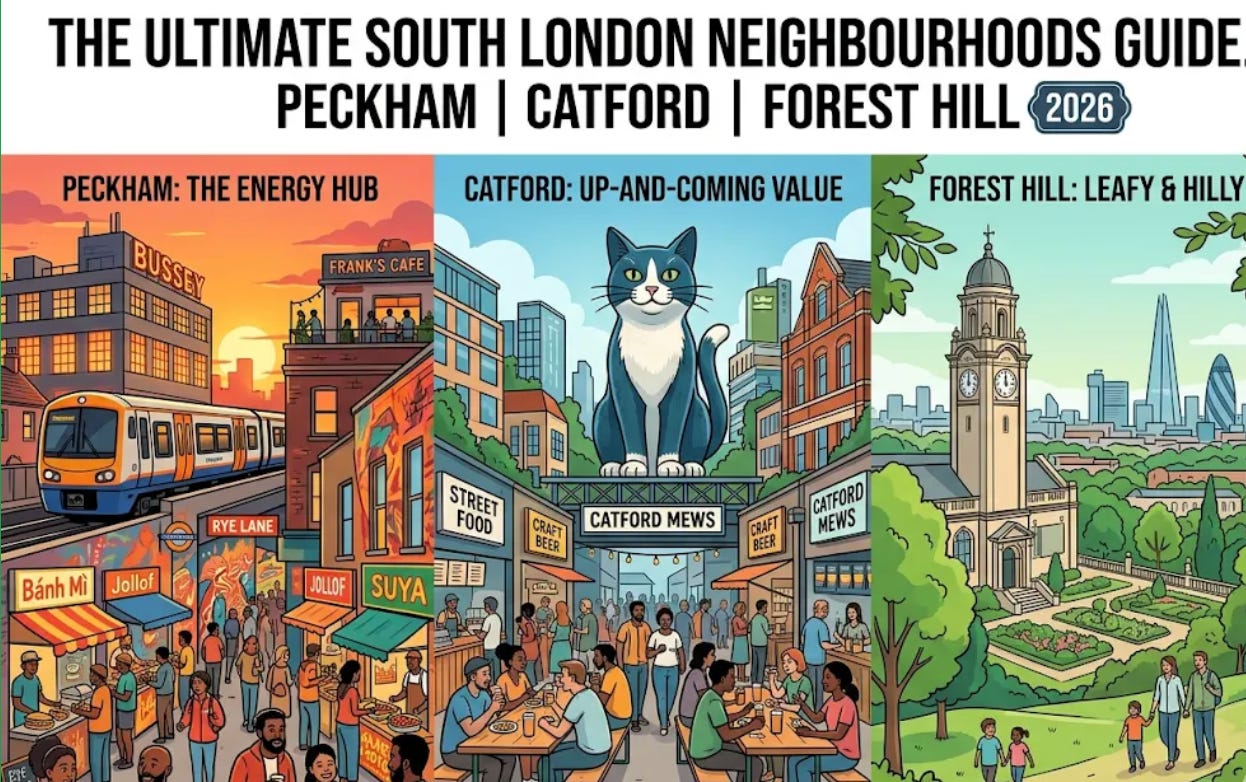
Peckham has been gentrifying for a long time now, and it’s worth being honest about that. The Bussey Building rooftop bar, Frank’s Cafe, and the wave of independent restaurants around Rye Lane have made it a destination rather than just a neighbourhood. Property prices have followed. A two-bedroom flat in Peckham (SE15) now typically sells for £450,000–£600,000. Average rents for a one-bedroom flat run around £1,700–£2,000 per month.
That’s not cheap. But it’s still considerably less than equivalent properties in Brixton, Clapham, or East Dulwich — and the return in character, food, and community is high.
What makes Peckham worth it in 2026 is the food scene. Rye Lane alone offers Vietnamese bánh mì, Ghanaian jollof rice, Turkish bakeries, Nigerian suya, and Korean fried chicken within a five-minute walk. The covered market on Rye Lane is one of the most genuinely diverse food markets in London. Kudu on Queens Road consistently ranks among London’s best small restaurants. Persepolis, the Persian deli on Peckham High Street, is a local institution beloved by the whole neighbourhood.
The honest caveat: Peckham is busier, louder, and more crowded than it was five years ago. The rooftop bars get heaving in summer. Rye Lane on a Saturday is genuinely chaotic. If you want the Peckham of the imagination — edgy, affordable, a bit rough around the edges — you’re a few years late. What you get now is a genuinely brilliant urban neighbourhood with excellent Overground connections and one of the best food cultures in the city. That’s still a very good deal.
Catford: The One That’s Still Becoming
Catford is where people who got priced out of Peckham went. And then fell in love with it.
There’s a reason Catford keeps appearing in “up-and-coming” lists: it’s genuinely in transition right now, in the best possible sense. The Catford Mews independent food market has been a catalyst, bringing street food, craft beer, and a sense of community gathering to a neighbourhood that needed a focal point. The Catford Cat — the enormous fibreglass cat above the Catford Centre shopping precinct — has become an unlikely icon, beloved and slightly surreal.
Property in Catford (SE6) is still meaningfully cheaper than Peckham. A two-bedroom flat typically ranges from £350,000 to £450,000. Average rents for a one-bedroom flat run around £1,300–£1,600 per month — making it one of the better-value options in Inner South London. Rail connections are good: Catford and Catford Bridge stations offer direct services to Blackfriars, Farringdon, and London Bridge, and Lewisham is close for DLR connections.
The community spirit here is something to seek out. The area has a strong Afro-Caribbean heritage, and the food options — Caribbean takeaways, West African restaurants, Turkish grills — reflect that beautifully. The Lewisham and Catford area has long been one of London’s most genuinely multicultural patches, and that hasn’t changed as the neighbourhood evolves.
The honest reality: parts of Catford are rough, and the high street has some work to do. But that’s exactly the energy that makes it interesting — it’s a neighbourhood actively becoming something, and being there now means you’re part of what it becomes.
Forest Hill: The One You Didn’t Expect
Forest Hill is the quiet one. Leafy, hilly, with views across the city on clear days, and a neighbourhood that somehow feels genuinely village-like despite being 20 minutes from London Bridge by train.
The Horniman Museum and Gardens is the defining local landmark — one of the most underrated museums in London, free to enter, with an impressive natural history collection and gardens that look out over the city skyline. The local café scene has improved dramatically over the past few years, with independent coffee shops and neighbourhood restaurants lining London Road.
Property in Forest Hill (SE23) averages around £550,000, with one-bedroom flats available from approximately £350,000. Rents average around £2,156 per month. The area attracts families, creative professionals, and people who want access to good state schools and green space without paying Dulwich prices.
Transport is purely on rail — Forest Hill station on the London Overground takes you into London Bridge in under 20 minutes. There’s no Tube, which is the constant refrain, but most residents stop noticing after a few weeks. The rail service is frequent enough that the absence doesn’t sting.
The honest truth about Forest Hill: it’s quieter and more suburban in feel than Peckham or Catford. It’s the family choice, the fresh-air choice, and the choice for people who value a slower Sunday. But the community is warm, the Horniman is extraordinary, and the views are genuinely some of the best in the city.
How to Choose Between Them
The right South London neighbourhood depends almost entirely on what you want from London life.
Choose Peckham if you want a world-class food scene, vibrant community, and a neighbourhood with genuine energy and character — and you can accept that it’s no longer a secret. Budget for £1,700–£2,000 in rent for a one-bed, or £450,000–£600,000 to buy.
Choose Catford if you want value, a neighbourhood in transition, and a genuine community feel without the tourist footfall. It’s the better choice for first-time buyers and anyone who wants to be early to something that’s clearly arriving. Budget for £1,300–£1,600 in rent for a one-bed, or £350,000–£450,000 to buy.
Choose Forest Hill if you want space, green access, good schools, and a quiet pace without compromising on transport. Budget around £2,156 average rent or £550,000 to buy.
FAQs
Q: Is Peckham safe to live in?
A: Peckham has improved significantly over the past decade and is now genuinely safe for most residents. As with anywhere in London, using common sense about routes and timing at night is advisable. The neighbourhood is vibrant and well-populated in the evenings, which itself contributes to safety.
Q: How long does it take to get to central London from Forest Hill?
A: Forest Hill station is on the London Overground and takes approximately 17–22 minutes to London Bridge, and around 35–40 minutes to further central destinations. There’s no Tube, but rail connections are frequent and reliable.
Q: Is Catford good for families?
A: Catford has good primary schools and access to parks and green space. It’s increasingly popular with young families who need more space than they can afford in Peckham or Brixton. The lower property prices allow families to buy with more room for their money.
Q: What are the best restaurants in Peckham?
A: Kudu on Queens Road is one of London’s best neighbourhood restaurants. Levan near Peckham Rye is excellent for a more relaxed dinner. The Rye Lane covered market offers extraordinary variety for casual eating across many global cuisines.
Q: Are there good schools in Forest Hill?
A: Forest Hill has a good selection of well-regarded primary schools and some strong secondary options nearby. Families should always research specific schools via Ofsted and check catchment boundaries before making decisions.
Q: Is South London getting a Tube line?
A: There are no confirmed plans for new Tube lines serving Peckham, Catford, or Forest Hill as of 2026. The Overground and National Rail serve these areas well, with ongoing improvements to frequency and reliability.
Q: How do South London rents compare to North London?
A: South London typically offers better value. A one-bedroom flat in Catford averages £1,300–£1,600 per month versus £1,800–£2,300 for similar properties in comparable North London areas like Islington or Stoke Newington.
Q: What’s the vibe in Catford like?
A: Catford has a strong community feel, a genuine multicultural character, and an arts scene that’s been quietly growing for several years. The Catford Mews market is a social hub, and the area has a warmth that’s harder to find in more polished neighbourhoods. It’s unpretentious and real.
Q: Is Forest Hill expensive?
A: By London standards, Forest Hill is mid-range. Average property prices of around £550,000 and rents averaging £2,156 are more accessible than comparable leafy areas like Dulwich or Blackheath, though higher than Catford. It’s good value for what it offers.
Q: Can I cycle from these areas to central London?
A: Cycling is feasible from Peckham — dedicated cycle lanes run towards London Bridge and Elephant & Castle. Catford and Forest Hill are hillier, making cycling less common but still manageable for committed cyclists.
DISCLAIMER
— A note from the editor
Destined for London shares my personal experiences, opinions, and independent research. Everything I write reflects what I’ve found to be true at the time of publishing — but London changes constantly, and what works for me may not work for you. Always do your own research and seek qualified professional advice before making decisions about property, finance, schools, healthcare, or anything else that matters. Some links in my posts are affiliate links, meaning I may earn a small commission at no extra cost to you. Sponsored content is always clearly labelled.