
The £160 Million Upgrade That Sees the Future
Part 4 of 4: The Hidden Tech Running London’s Buses

Series Navigation:
Part 1: Your Bus Stop Is Lying to You (But in a Good Way)
Part 2: When Buses Talked to Lampposts: London’s Pre-GPS Miracle
Part 3: Your Bus Is Negotiating With Traffic Lights (Yes, Really)
Part 4: The £160 Million Upgrade That Sees the Future ← You are here
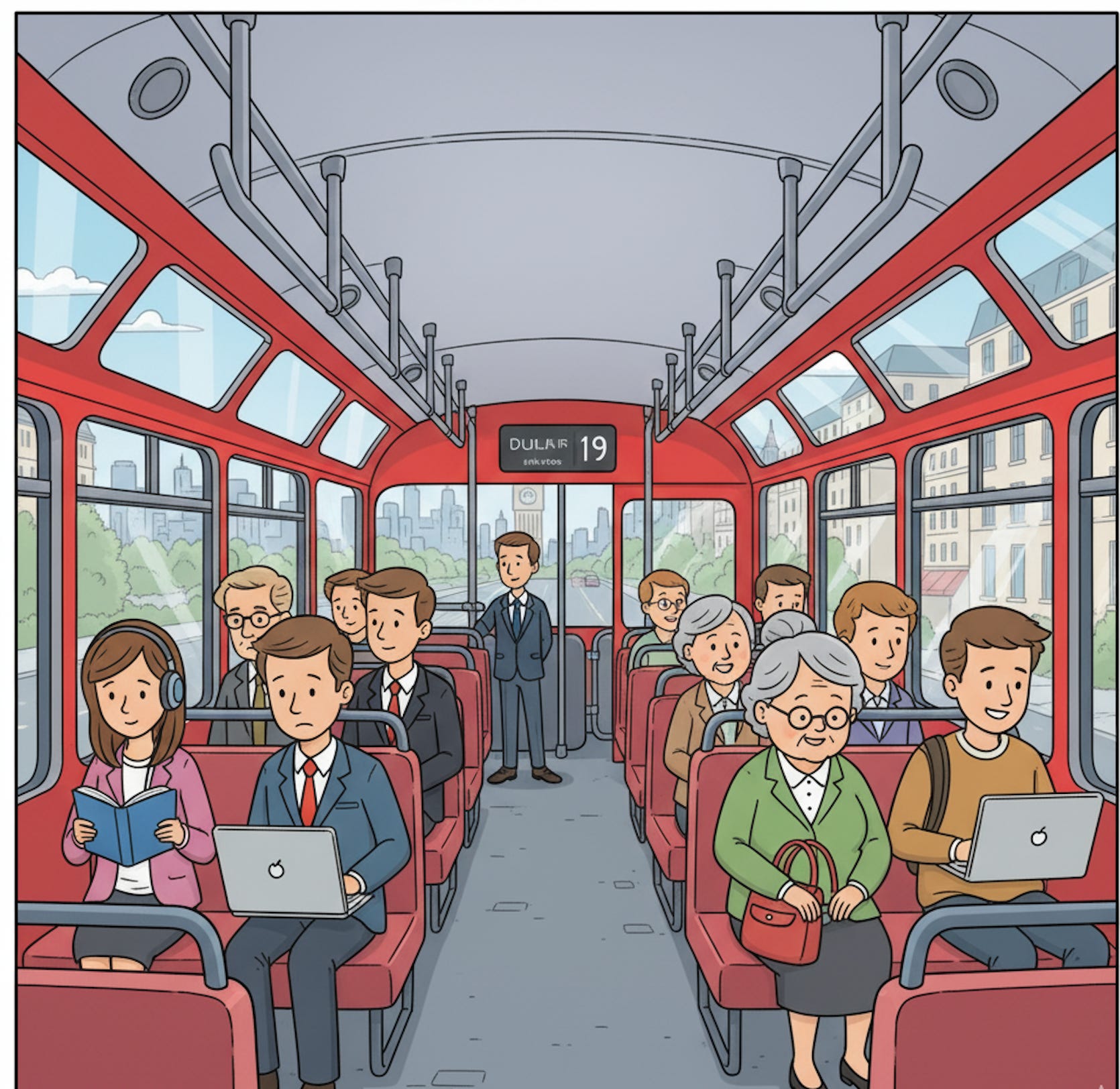
Imagine you’re on a bus heading into central London on a Monday morning. The traffic’s moving smoothly. Your countdown screen says you’ll arrive at your stop in eight minutes. You relax, maybe check your emails, confident in that prediction.
But here’s what you don’t know: three miles ahead of you, traffic is slowing to a crawl. Roadworks have narrowed the road. Buses ahead of you are already getting stuck.
In the old system, you wouldn’t know about this until your bus reached the delay. Your eight-minute estimate would suddenly become twelve, then fifteen, with no explanation. The countdown would slow down, leaving you wondering what went wrong.
In the new system? The countdown already knows.
It’s seen what’s happening ahead, recalculated based on the actual conditions the buses in front of you are experiencing, and adjusted your arrival time accordingly. By the time your bus reaches the delay, you’ve known about it for ten minutes. You can adjust your plans, send a message, relax instead of wondering.
This is iBus 2. And it’s not just an upgrade, it’s a fundamental shift in how London’s buses understand and navigate the city.
The £160 Million Investment
In 2024, Transport for London unveiled a new generation of bus tracking technology. The price tag? £160 million.
That’s a lot of money. But here’s why it costs so much: they’re not just adding new features to the old system. They’re replacing the physical technology on every single one of those 9,000 buses, and they’re building it in a way that makes future upgrades easier and cheaper.
Think of it like finally replacing the pipes in an old house. Yes, it’s expensive and disruptive now. But once it’s done, you’ve got modern infrastructure that won’t need ripping out and replacing every time you want to add something new.
The system is modular and open, which in tech speak means it can be upgraded piece by piece without replacing everything. It’s designed for the next 20 years, not just the next five.
Learning From the Road Ahead
The headline feature of iBus 2 is its ability to learn in real-time.
The old iBus system knew where your bus was and could estimate when it would arrive based on typical journey times for that route at that time of day. It was using historical data—what usually happens—to predict the future.
iBus 2 does something more sophisticated: it uses live data from buses further along the route to understand what’s happening right now on the road ahead.
If several buses ahead of you are slowing down at a particular point, the system registers this. It understands that there’s congestion, or an incident, or unusually heavy traffic. And it adjusts the predictions for all the buses behind them accordingly.
It’s not waiting for your bus to hit the delay before updating your arrival time, by anticipating the delay based on what other buses are experiencing.
This is predictive intelligence. The system isn’t just tracking it is learning and forecasting.
Solving the Diversion Problem
Here’s something that’s frustrated Londoners for years: route diversions.
Roadworks close a street. A parade shuts down the high road. An emergency incident blocks the usual route. And suddenly, your bus is taking a completely different path, but the countdown screens and apps have no idea what’s happening.
You watch your bus on the map taking bizarre turns, heading in apparently random directions, whilst the system insists it’s somehow still three minutes from your stop. It’s digital confusion.
iBus 2 finally solves this.
The system can now understand and communicate diversions dynamically. When a bus deviates from its usual route, the system recognises the diversion, updates the route in real-time, and communicates this to passengers through the apps and displays.
No more mystery detours. No more buses vanishing from the map. Just clear information about what’s happening and when you’ll actually arrive.
The New Displays
Walk around London now and you’ll start noticing new bus stop displays. They come in two types, depending on how busy the stop is.
At smaller, quieter stops, Transport for London is installing e-ink displays—the same technology used in Kindle readers. These are perfect for locations that don’t need super-bright screens. They’re low-power, easy to read in sunlight, and clear enough for essential information.
At busier stops and major hubs, you’ll see full-colour LED displays. These can show more information, handle multiple routes clearly, and are bright enough to be visible even in direct sunlight or at night.
Both types are connected to iBus 2, which means they’re displaying those smarter, more accurate predictions. They can show diversion information. They can tell you about delays with actual context instead of just making the numbers tick up mysteriously.
The goal is to have these new displays at thousands of stops across London, replacing the ageing technology that’s been in place for years.
The Bigger Picture: A Cleaner Network
All of this technological advancement is happening alongside another massive transformation: London’s bus fleet is going green.
As of 2025, London operates more than 2,000 zero-emission buses—that’s over 20% of the entire fleet. These are electric or hydrogen-powered vehicles, producing no tailpipe emissions in one of the world’s most congested cities.
The iBus 2 system is designed to work seamlessly with these new vehicles. It can monitor battery levels, optimise routes for electric buses, and help manage the complexity of a mixed fleet—some diesel, some hybrid, some pure electric—all running together across the network.
This matters because London isn’t just trying to make buses more trackable. It’s trying to make them cleaner, quieter, and more efficient. The tracking technology supports that bigger environmental mission.
By 2030, Transport for London aims to have one of the largest zero-emission bus fleets in the world. The smart tracking systems help make this transition operationally possible, ensuring that electric buses can be managed just as effectively as traditional vehicles.
From Reactive to Predictive
Looking back across this series, the evolution is striking.
In 1992, the system was reactive—it could only tell you where a bus had been.
By the mid-2000s, with iBus, it became real-time and could tell you where a bus was right now.
With iBus 2, it has become predictive and can tell you where a bus will be, based on what’s happening across the network.
That’s not just a technical improvement. It’s a fundamental change in how the system understands the city.
London’s buses are no longer just vehicles being tracked. They’re part of a living, breathing, learning network that adapts to what’s happening on the road, anticipates problems, and adjusts in real-time.
The Human Dimension
But for all this technology, the goal remains wonderfully simple and human: making your journey less stressful.
No one boards a bus thinking about predictive algorithms or real-time data integration. They’re thinking about getting to work, getting home, getting to an appointment on time.
They trust that little countdown screen. They believe the number it shows them. And decades of engineering—from lampposts to satellites to machine learning—have gone into making that trust justified.
The Invisible Systems That Run Cities
This series started with a simple question: how does London track 9,000 buses?
The answer, as it turns out, is complicated. It’s not one clever solution, but layers of solutions built over 30 years. Some bits are brilliant. Some bits are bodges. Some bits are boring database work that no one celebrates but everyone relies on.
And that’s true of almost every city system you take for granted.
The traffic lights that somehow keep London moving? There’s a sophisticated control system behind them. The water that comes out of your tap? Someone’s monitoring reservoir levels and pipe pressure across hundreds of miles of infrastructure. The electricity that powers your home? There’s a grid being balanced in real-time, every second of every day.
Cities work because of invisible infrastructure. Because of engineers solving unglamorous problems. Because of systems that evolved over decades, layer by layer, solving one issue at a time.
Your bus countdown is just one example. But once you start noticing these systems, you see them everywhere.
The Epilogue
London’s buses still don’t run to an unchangeable, precise timetable. They probably never will. On complex city roads, delays are part of the deal—you can’t eliminate them entirely without, you know, eliminating all the other traffic, which feels impractical.
But what’s changed over 30 years is that delays are less common, less severe, and far less mysterious than they used to be.
You know when your bus is coming. You know if it’s delayed and often why. You can plan accordingly. That small bit of control that ability to make an informed decision about your journey should make urban life tangibly better.
And that’s worth celebrating, even if the air conditioning still doesn’t work.
That’s the end of this series, but I’d love to hear from you. What other invisible city systems do you want to know about? What bits of urban infrastructure do you take for granted but wonder how they actually work?
And if you’ve enjoyed these deep dives into London’s transport systems, please share this series with anyone who appreciates a good story about clever engineering. The next time they’re waiting at a bus stop, they’ll see it differently.