
The Best Free Things to Do in London in 2026 (That Aren't on Any Tourist Map)
Here’s the thing about London that takes people by surprise: one of the world’s most expensive cities is also genuinely generous with its culture. You can spend an entire week exploring world-class museums, hidden gardens, and architectural treasures without opening your wallet once.
That’s not hyperbole. It’s one of those rare truths that make London special.
Most guides point you toward the obvious answer — the British Museum, the National Gallery, the Natural History Museum. Those are brilliant. But if you want to feel like you’ve discovered London rather than just ticked a box, there are stranger, quieter, more wonderful places waiting. Here are the free attractions that actually matter.
The Major Free Museums That Live Up to the Hype
The British Museum isn’t just free; it’s genuinely life-changing. The Rosetta Stone, Egyptian mummies, the Parthenon sculptures — these are objects that shaped how humans understand history. Go on a Tuesday or Wednesday morning if you can, queue less, see more.
The Natural History Museum is the most popular free tourist attraction in the entire UK. Yes, it gets rammed. Yes, it’s worth it. The dinosaur hall deserves the crowds. Pro tip: if you’re visiting as a resident (not a tourist), you can often get quieter hours by visiting mid-week or early morning.
The V&A South Kensington is my favourite major museum, partly because it’s often quieter than the others. Fashion, photography, design, ceramics — it feels less like a duty and more like wandering through someone’s extraordinary personal collection. And honestly? The building itself is a masterpiece.
Tate Modern, in a former power station on the South Bank, is where contemporary art lives. Free permanent galleries, stunning views from the viewing level, and a riverside location that makes the whole experience feel less like “going to a museum” and more like hanging out in an impossibly cool public space.
The National Gallery and Science Museum are equally free and equally brilliant. The Science Museum especially is underrated for adults — the transport section will make you nostalgic, and the social history galleries are genuinely moving.
The National Portrait Gallery and Museum of London Docklands round out the list. Portraiture is deeply underrated as a way to understand culture, and the Docklands museum tells London’s story through the people who built it.
The Genuinely Weird and Wonderful Free Gems
This is where London gets interesting.
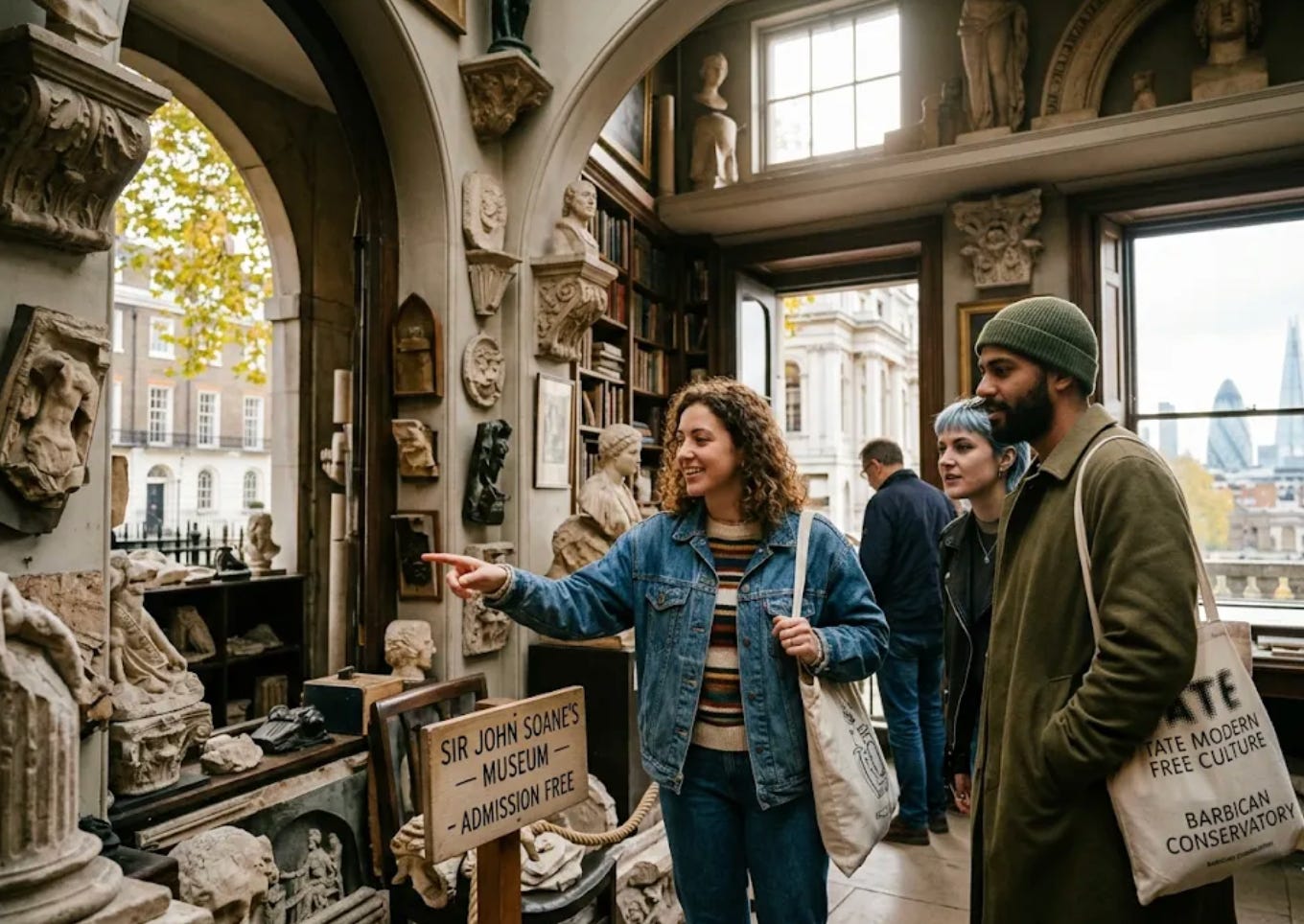
Sir John Soane’s Museum (13 Lincoln’s Inn Fields, WC2A 3BP) is unlike anything else. An 18th-century architect’s three townhouses, packed floor-to-ceiling with objects — paintings, sculpture, even a sarcophagus of King Seti I. It’s chaotic, intimate, slightly magical. The Hogarth paintings alone (A Rake’s Progress) are worth the short walk from Holborn. And it’s completely free.
The Barbican Conservatory is the plot twist. It’s a hidden garden inside a Brutalist fortress, 2,000-plus tropical plants thriving in the heart of the city. Free tickets are released every Thursday at 9:30am and disappear within minutes. Get up early, refresh your browser, and you’ll have an hour in actual jungle. It feels like cheating. (If you miss the free slots, paid entry is minimal.)
Watts’ Memorial to Heroic Self-Sacrifice, tucked away in Postman’s Park near St Paul’s, might be the most unusual museum in London. Victorian ceramic tiles honouring ordinary people who died saving others. A maid who died rescuing children from fire. A worker who stayed at his post to prevent a catastrophe. It’s eerie, moving, and absolutely free. You’ll have it mostly to yourself.
The Guildhall Roman Amphitheatre is buried — literally — under the City of London. A 2nd-century gladiatorial arena, discovered by accident, now viewable for free from a small viewing chamber. Walking into this underground space feels like time travel.
The Hunterian Museum (Royal College of Surgeons) is for people who love a bit of the macabre. Medical specimens, anatomical displays, surgical instruments. It’s strange and brilliant and completely free.
Outdoor London: Parks, Towpaths, and Swimming
Hampstead Heath is a 320-acre common that feels like countryside in the middle of the city. Free to roam. The swimming ponds (three of them) do charge a small fee, but the Heath itself is yours to explore. On a sunny day, it’s the most London thing you can do.
Richmond Park is massive (2,500 acres) and free, with roaming herds of actual deer. The deer are wild but accustomed to humans; you can get shockingly close. It’s genuinely a different London.
Regent’s Canal towpath walk is a favourite of mine. Especially the stretch from King’s Cross north to Hampstead Road — utterly transformed in recent years, now flanked by independent cafés, galleries, and green space. Walk it for free, stop for coffee, watch the narrowboats pass.
Southbank riverside walk is London’s second-best free activity after the museums. Millennium Bridge south to Tower Bridge, watching the light change on the Thames, catching a free concert at the Southbank Centre most days. This summer, the Southbank Centre is celebrating its 75th anniversary with an expanded programme of completely free events.
Victoria Park and Greenwich Park are both excellent. Greenwich is especially good if you’re interested in maritime history — it’s got views that have barely changed since the 18th century.
Free Culture Worth Your Time
Southbank Centre free events are genuinely good, not just “free but terrible.” During the 75th anniversary year, there are additional free concerts, talks, and performances happening regularly. Check their events listing.
Southbank Centre Book Market happens daily — second-hand books, bargains, brilliant finds. It’s free to browse and remarkably cheap to buy.
Notting Hill Carnival (August bank holiday) is free, vast, joyful, and chaotic. If you’ve never experienced Caribbean culture in London, this is non-negotiable.
V&A East, which opened on 18 April 2026, has free permanent galleries. Same access, new location. It’s worth visiting just for the building itself.
The Real Truth About Free London
What strikes me about London’s generosity with culture is that it’s not accidental. It’s a choice that says: this heritage belongs to everyone, not just people with money. That matters.
Some of these spaces — Sir John Soane’s Museum, the Hunterian — are small and strange enough that you’ll likely have them mostly to yourself. Some are rammed and still worth the queue. All of them are remarkable.
You genuinely can know London deeply without spending much money at all. That’s not a consolation prize. That’s the real thing.
FAQs
Q: Do I really need to book ahead for the major museums?
A: Not always for just dropping in, but if you want to skip queues, booking is smart. Tuesday–Thursday mornings are genuinely quieter. The Barbican Conservatory, though, absolutely requires booking (and is first-come, first-served on Thursdays at 9:30am).
Q: Are the free museums actually busy?
A: Yes, especially school holidays and weekends. Weekday mornings, genuinely not. Early openings (often 8 or 9am) are golden.
Q: Is Hampstead Heath safe for swimming?
A: Yes. The ponds are monitored, water quality tested regularly. It’s a bit cold even in summer, but people swim year-round.
Q: How long would it realistically take to see the British Museum?
A: If you actually try to see everything, weeks. If you want to hit the highlights, 4–6 hours is realistic. Pick highlights, come back.
Q: Can I bring my own picnic to parks?
A: Absolutely. Parks are made for picnics. Bring wine, bring cheese, bring friends.
Q: Which museum is best if I only have two hours?
A: The V&A, honestly. You can do highlights and leave satisfied. The Natural History Museum is also good for a quick visit.
Q: Are events at Southbank Centre really free?
A: Many are, yes. Check their website — they list free performances daily during summer months.
Q: Is there anywhere to eat cheaply near the major museums?
A: Museum cafés are reasonable. Better: bring supplies and picnic in the park. St James’s Park near the National Gallery is stunning for this.
Q: Can you go swimming in the Thames?
A: Not really. Hampstead Heath ponds, yes. The Thames, no. Water quality isn’t great, and it’s not permitted in most areas.
Q: What’s the best free walk in London?
A: Regent’s Canal from King’s Cross northward, or the Thames Path from Westminster to Tower Bridge. Both are long, beautiful, completely free.