
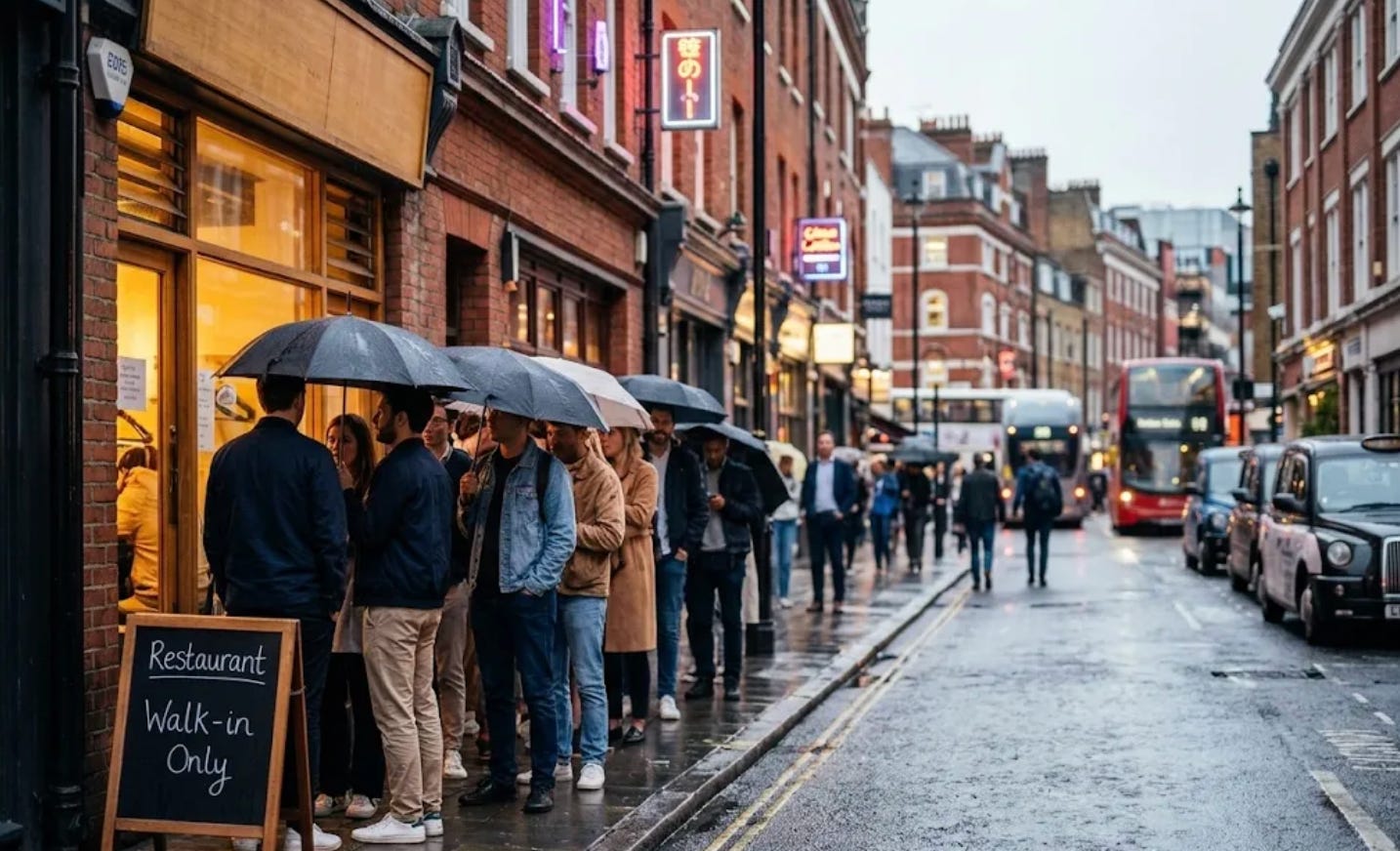
London has a complicated relationship with restaurant queues. Some are genuinely worth it — places where the food is so good, or the experience so distinctive, that a 30-minute wait feels entirely reasonable. Others are the product of clever marketing, social media visibility, and the human tendency to assume that a queue means quality.
Here’s my honest assessment.
A note before we start: I don’t name-and-criticise specific restaurants. What I do is describe the category and the type of experience, and give you the tools to make your own judgment. Restaurants change — chefs leave, quality shifts, the buzz fades. My views reflect my experience at the time of writing.
Queues Generally Worth It
Japanese and Korean Casual
The best Japanese ramen shops, Korean fried chicken spots, and Japanese-influenced casual restaurants in London tend to be small, no-reservation, and genuinely excellent. The queues at these places are usually worth it because the economics are clear: the operators are small, the kitchen is tiny, the food is brilliant, and there’s no business model that involves taking reservations and sitting empty tables.
In my experience, queues at these restaurants move reasonably quickly (high turnover), and the food consistently justifies the wait.
The Classic British Institution
Certain London institutions — pie and mash shops, the best fish and chip restaurants, specific celebrated delis — have queues that are part of their social function rather than mere demand overflow. St John Bakery bread queue on weekday mornings is as much a community ritual as a retail transaction. The quality justifies the wait and the queue is part of the experience.
Street Food at Its Source
The queue at a specific market stall — a particular Caribbean jerk chicken trader at Brixton Market, the specific Ethiopian food stall that locals go to at Walthamstow Market — is almost always worth it because these places have no incentive beyond cooking good food. The queue is genuine demand from people who know what they’re getting.
Queues Often Not Worth It
Social Media-Driven Concepts
Restaurants and food concepts that are primarily Instagram-famous — elaborate desserts, instagrammable platings, novelty foods — often generate queues that significantly exceed the quality of the food. In my experience, if the primary marketing of a food place is visual spectacle rather than flavour, the queue is more often a reflection of social media momentum than genuine quality.
Central London Tourist-Adjacent Queues
Long queues outside certain central London restaurants in high-traffic tourist areas are not always a quality signal. They can reflect: tourist footfall (visitors defaulting to the place with the biggest queue), social proof (people seeing others queue and joining), and PR-generated buzz that doesn’t reflect current day-to-day quality.
Before queuing at a central London restaurant, I’d check a few recent reviews beyond TripAdvisor — specifically looking for what repeat visitors and local regulars say.
The Queue That Exists Because of No Reservation Policy Only
Some excellent restaurants don’t take bookings not because they’re being cool about it, but because their business model works better that way — higher turnover, lower admin. That’s fine and often produces genuinely good experiences.
But some restaurants don’t take reservations because creating a queue is free marketing. The visual of a queue outside a restaurant signals popularity. If the no-reservation policy is primarily a marketing decision, the queue doesn’t tell you much about the food.
The Smart Approach
Arrive at opening or at an off-peak time. Most popular no-reservation restaurants have zero queue at 11:30 am for lunch or at 5:30 pm for dinner. Turning up at 1 pm on a Saturday is choosing to queue.
Ask for recommendations from locals for your specific cuisine. The best Vietnamese restaurant in Dalston, the best jerk chicken in Brixton, the best Sri Lankan in Tooting — the people in those communities know. The queuing restaurants in Soho may not be where the relevant community eats.
Weigh the opportunity cost. A 45-minute queue for a restaurant in central London is 45 minutes of walking, browsing, or sitting in a garden. Is the food — honestly assessed — worth it?
FAQs
1. Should I queue for Dishoom in London?
Dishoom is genuinely good — in my experience, the food is consistently high quality and the atmosphere is excellent. Whether the queue is worth it depends on your patience and the time of day. The King’s Cross branch tends to have shorter waits than the Covent Garden original.
2. How long do London restaurant queues typically take?
At popular no-reservation restaurants, 20–45 minutes is typical at peak times. Some are longer. Most have a system for taking your number and calling you when a table is ready, which allows you to wait nearby rather than in a physical queue.
3. Are there any London restaurants worth queuing an hour for?
In my opinion, very few — and those that are tend to be producing something genuinely unique that can’t be replicated elsewhere. An hour is a significant opportunity cost in a city this full of excellent food.
4. What’s the best time to visit popular London restaurants?
Weekdays, at opening time. Monday to Wednesday lunches at most popular restaurants are significantly less crowded than Thursday–Sunday.
5. Are walk-in-only restaurants common in London?
Yes — particularly in the casual and street food categories. Many excellent restaurants don’t take bookings, and this is a deliberate choice rather than a limitation.
6. What’s the best way to get a table at a popular London restaurant?
Book well in advance (many top restaurants open bookings 4–8 weeks ahead). Turn up at opening time for walk-in spots. Check for cancellations on apps like Resy or OpenTable.
7. Are booking fees normal for London restaurants?
Increasingly yes — some popular restaurants charge a deposit or booking fee to reduce no-shows. This is generally refunded if you cancel in advance. Read the terms before booking.
8. Is there a restaurant area in London that’s worth exploring specifically?
In my experience, the Berwick Street and surrounding Soho streets, the Maltby Street/Bermondsey area, and the Dalston/Kingsland Road stretch are the most rewarding areas for serious food exploration.
9. What does ‘walk-in only’ mean in London restaurants?
No reservations taken — you turn up and wait for a table. Some walk-in restaurants have a waitlist system where you add your name and phone number and are notified when a table is available.
10. Is the food at queued London restaurants really better than elsewhere?
Sometimes yes, sometimes no. In my experience, the best food in London is often found at places with no queue at all — local neighbourhood restaurants in Tooting, Dalston, Hackney, and Peckham that are cooking excellent food for the communities they serve.
— A note from the editor
Destined for London shares my personal experiences, opinions, and independent research. Everything I write reflects what I’ve found to be true at the time of publishing — but London changes constantly, and what works for me may not work for you. Always do your own research and seek qualified professional advice before making decisions about property, finance, schools, healthcare, or anything else that matters. Some links in my posts are affiliate links, meaning I may earn a small commission at no extra cost to you. Sponsored content is always clearly labelled. Read the full Terms and Privacy Policy.