
The London Underground's Most Beautiful Stations (Most Visitors Walk Right Past Them)
Most people use the London Underground as pure infrastructure — a means of getting from A to B with the minimum possible attention to surroundings. This is understandable. It’s also a shame, because the Underground has some of the most extraordinary station architecture of any metro system in the world.
Here are the stations worth actually looking at.
The Charles Holden Stations: 1920s–1930s Modernism
Charles Holden designed a series of stations for London Transport in the 1920s and 1930s that are among the finest examples of modernist architecture in Britain. They combine functionalism with an extraordinary sense of calm and purpose.
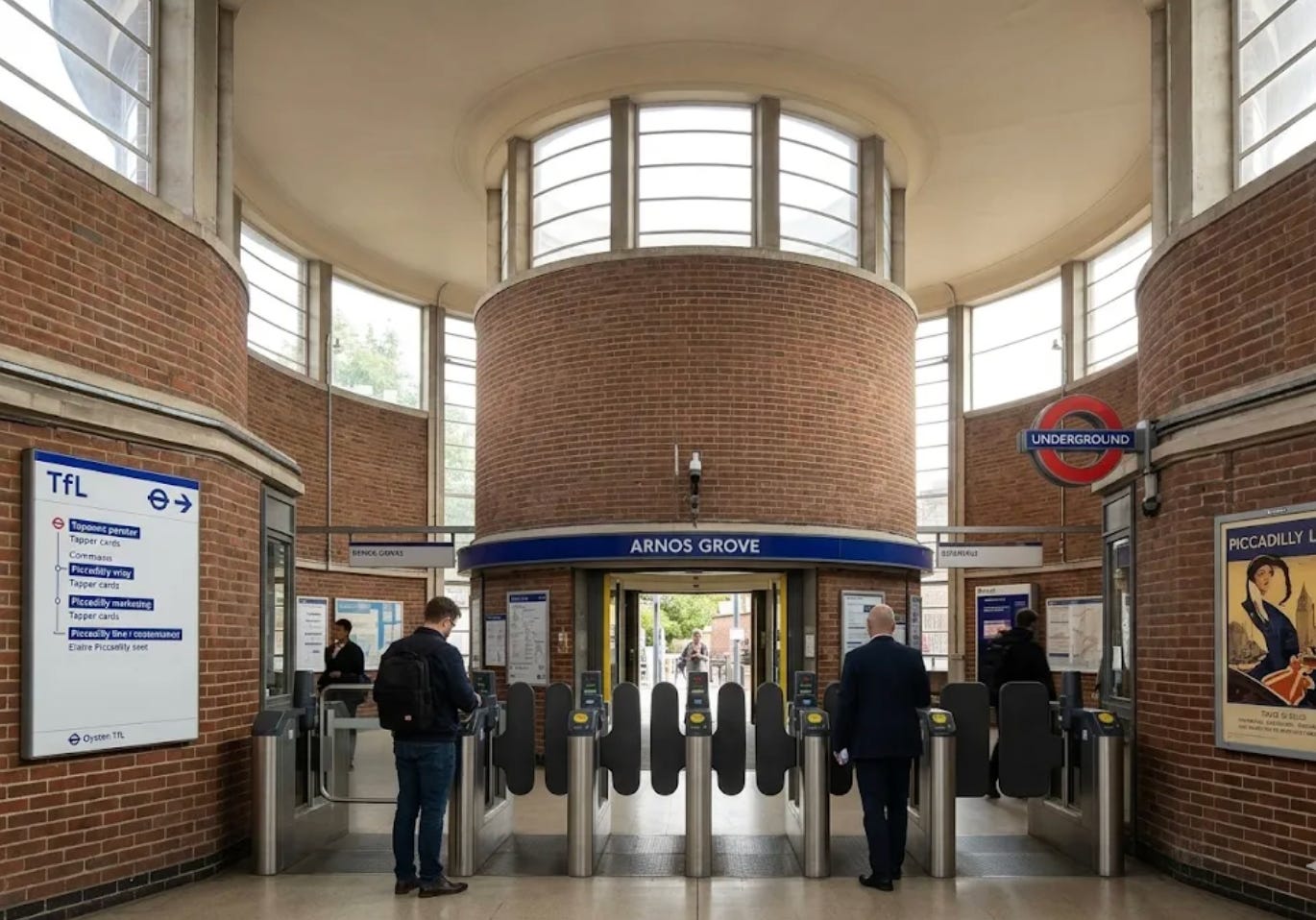
Arnos Grove (Piccadilly line): A circular booking hall of brick and glass — simple, functional, extraordinary. The centrepiece is a cylindrical drum with windows running around the full circumference. One of the most beautiful circular buildings in England. Exit the station and look back at it.
Southgate (Piccadilly line): A companion piece to Arnos Grove — another Holden circular station with a flying saucer roof. The street-level shopping parade that wraps around the station building is also Holden’s design and is in excellent condition.
Sudbury Town (Piccadilly line): The prototype for Holden’s brick station designs — flat-roofed, brick-faced, with large windows. Influential across the whole network and still looking as contemporary as it did in 1931.
The Victorian Survivors
Gloucester Road (District, Circle, Piccadilly lines): The original 1868 station building survives largely intact — Victorian ironwork, the original platform canopies, and a disused station platform between the working platforms that has been used as a gallery space. Look up when you arrive.
Baker Street (Metropolitan, Circle, District, Hammersmith and Jubilee lines): Contains sections of the world’s first underground railway (the Metropolitan Railway, opened 1863). The section of the original underground is preserved and the atmosphere — vaulted Victorian brickwork, old-fashioned signage — is unlike any other station on the network.
Contemporary Architecture Worth Noticing
Canary Wharf (Jubilee line): The station by Norman Foster — a huge glazed canopy over a deep-cut station box in the Docklands. The scale is extraordinary; the engineering even more so. Worth arriving early and looking up rather than rushing for a train.
Southwark (Jubilee line): Will Alsop’s station has a ticket hall with deep blue walls, indirect lighting, and geometric forms that make it feel like a contemporary art installation. One of the most distinctive interiors on the modern Jubilee line extension.
Westminster (Jubilee, Circle, District lines): The Jubilee line extension platforms designed by Michael Hopkins are genuinely spectacular — a deep concrete structure with exposed engineering elements that recalls Piranesi’s prison etchings more than conventional transport infrastructure. Go to the Jubilee line platforms and look up.
The Art on the Walls
Beyond the architecture, the Underground has an extensive programme of commissioned public art:
Tottenham Court Road has Eduardo Paolozzi’s original mosaic tiles (1984) lining the station walls — brightly coloured Pop Art imagery covering hundreds of metres of tunnel. Some were removed during the Crossrail works; what remains is extraordinary.
King’s Cross St. Pancras has had various art commissions over the years. The ceiling of the Circle/Metropolitan line ticket hall in particular has a dramatic visual presence.
Practical Note
TfL’s website has resources on Underground architecture and art. The London Transport Museum in Covent Garden (admission charge, excellent) covers the history and design of the network in detail, including Holden’s stations.
FAQs
1. Are tube stations free to visit?
To access the station and look around, you need a valid ticket or Oyster card. The stations themselves are not visitor attractions with separate entry. The best approach is to include them in journeys you’re already making, or to visit via a specific tube trip.
2. Which is the oldest London Underground station?
Baker Street, on the world’s first underground railway (opened January 1863).
3. Who was Charles Holden?
Architect (1875–1960) who designed the majority of London Underground’s stations in the 1920s and 1930s, establishing a distinctive modernist aesthetic that influenced the whole network. One of the most important British architects of the 20th century.
4. What is the London Transport Museum?
A free-to-enter (with a London Transport museum membership, or paid admission) museum in Covent Garden covering the history of London’s transport networks. The collection includes historic vehicles, maps, posters, and architectural material. Highly recommended for anyone interested in urban design or the Underground.
5. Are the Eduardo Paolozzi mosaics at Tottenham Court Road still visible?
At the time of writing, some sections were removed or repositioned during the Crossrail works. The remaining mosaics are still in the station but the configuration has changed from the original. Check current status via TfL.
6. What is the Jubilee line extension?
The 1999 extension of the Jubilee line from Green Park to Stratford, passing through Westminster, Waterloo, Southwark, Bermondsey, Canada Water, Canary Wharf, North Greenwich, and Canning Town. Each station was designed by a different architect, resulting in one of the finest sequences of contemporary station architecture anywhere in the world.
7. Can I photograph inside London Underground stations?
Personal photography is generally permitted. Tripods and commercial photography require permission from TfL.
8. Are there guided tours of tube architecture?
Yes — the London Transport Museum runs specific tours of the network’s architectural highlights, including some disused stations. These sell out quickly.
9. What are the disused London Underground stations?
London has several disused (’ghost’) stations, including Aldwych (a branch off the Piccadilly line, closed 1994), Down Street (Piccadilly line, closed 1932, used by Churchill as a command post in WWII), and Brompton Road. Some are visible from passing trains; occasional tours run via the London Transport Museum.
10. Which station has the best-preserved Victorian interior?
In my opinion, Baker Street — particularly the Metropolitan line platform area — has the most evocative surviving Victorian Underground atmosphere.
— A note from the editor
Destined for London shares my personal experiences, opinions, and independent research. Everything I write reflects what I’ve found to be true at the time of publishing — but London changes constantly, and what works for me may not work for you. Always do your own research and seek qualified professional advice before making decisions about property, finance, schools, healthcare, or anything else that matters. Some links in my posts are affiliate links, meaning I may earn a small commission at no extra cost to you. Sponsored content is always clearly labelled. Read the full Terms and Privacy Policy.