
Twenty years ago, you wouldn’t have lingered at King’s Cross. It had a reputation — and not the kind that made the estate agents enthusiastic. Rough sleepers, dodgy corners, a station you passed through rather than stayed at. If you mentioned you lived nearby, people raised an eyebrow.
Now? They want to know if there are any flats available.
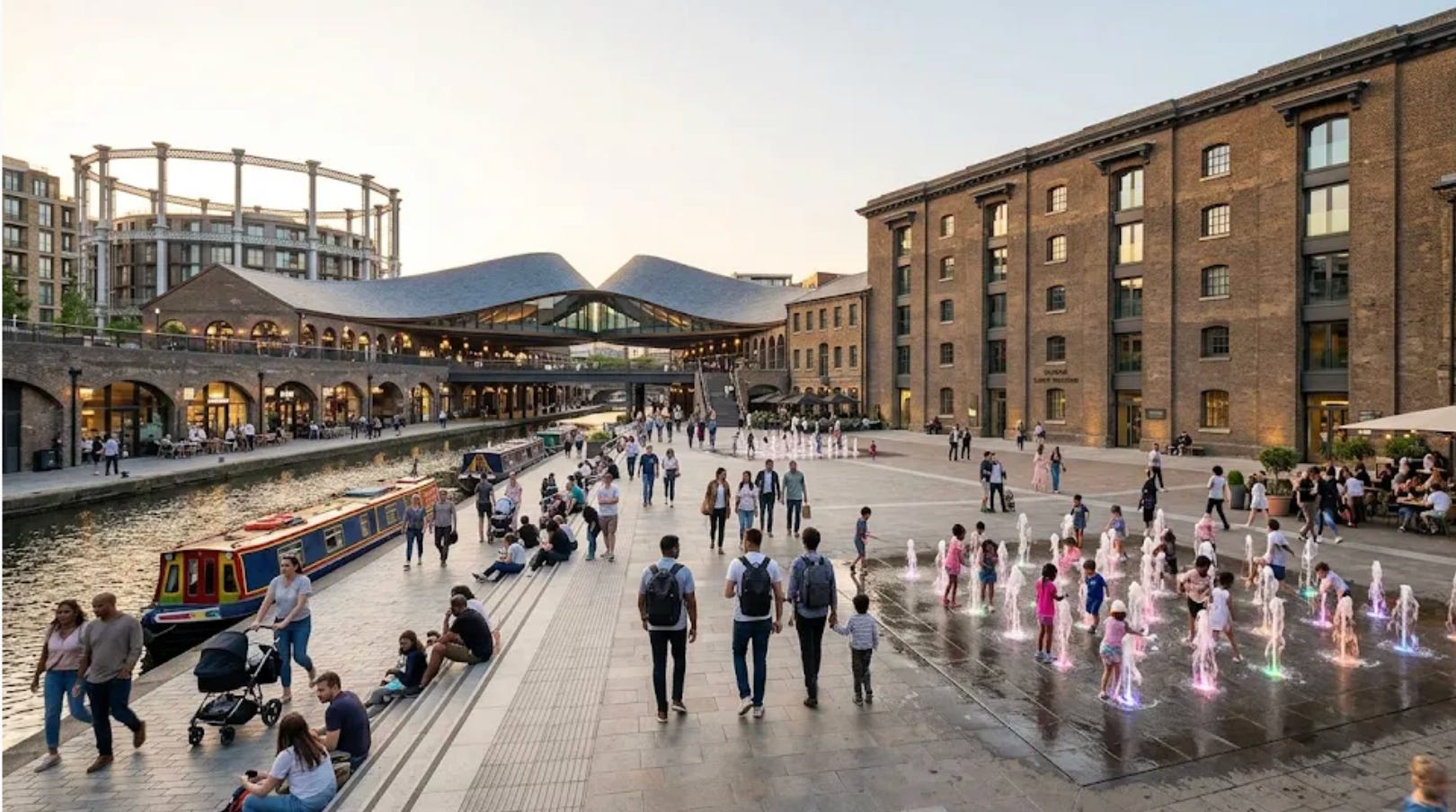
The transformation of King’s Cross is one of the most dramatic urban regeneration stories in modern London. A derelict 67-acre industrial site has become a thriving neighbourhood with world-class restaurants, galleries, a university campus, and one of the most photographed public squares in the city. Google, Universal Music, and Louis Vuitton have set up shop here. Families push buggies along canalside paths where freight trains once rumbled.
But is it all gloss and no substance? Is it worth the price tag? And what’s it actually like to live here in 2026?
This guide gives you the honest picture — the brilliant bits and the bits that still need work.
From Coal Drops to Cool Drops: A Brief History
King’s Cross takes its name from a short-lived monument to King George IV, erected at the crossroads in 1830 and demolished just a few years later. What it kept was the railway.
By the mid-19th century, King’s Cross and St Pancras stations made this one of the busiest transport hubs in the country. The land behind the stations became industrial — gasholders, coal drops, goods yards. It powered Victorian London but wasn’t pretty.
By the late 20th century, the industrial use had faded and the area fell into decline. The 1987 King’s Cross fire, which killed 31 people on the Underground, deepened the area’s dark associations.
Then came the plan. Argent, the developer, took on the 67-acre King’s Cross Central site in the early 2000s. The brief was ambitious: a mixed-use neighbourhood with housing, offices, culture, and public space — all connected to the two mainline stations.
The result, completed in phases from 2012 onwards, is what you see today. Coal Drops Yard — the name is literal; coal was once unloaded here from canal barges — is now a designer retail and dining destination with a swooping roofline designed by Thomas Heatherwick. The coal drops themselves are Grade II listed. The industrial bones are part of the beauty.
What’s Here Now: The New King’s Cross
Granary Square
This is the centrepiece — a wide, handsome public square on the Regent’s Canal, surrounded by Victorian granary buildings repurposed as offices, restaurants, and the home of Central Saint Martins, one of the world’s most celebrated art and design colleges.
In summer, the fountains in Granary Square are full of children. In winter, there are outdoor cinema events and Christmas markets. It genuinely feels like a neighbourhood square rather than a corporate plaza — which is no small achievement given it was built from scratch.
The canal towpath connects you west towards Camden and east towards Islington. It’s a lovely walk either direction, flat and mostly traffic-free.
Coal Drops Yard
Think of it as a boutique alternative to a shopping centre. You’ll find Paul Smith, Tom Dixon, Cowshed, independent chocolatiers, record shops, and a cluster of excellent restaurants and bars all tucked under those distinctive arched brick vaults.
It’s atmospheric in a way that most retail developments simply aren’t. The architecture does a lot of heavy lifting. Even if you’re not buying anything, it’s worth walking through.
Lewis Cubitt Park and the Gasholders
The restored Victorian gasholders — enormous cast-iron frames that once held gas storage tanks — now frame a circular park and a block of premium flats. It’s a striking bit of heritage design. Lewis Cubitt Park nearby is a calm green space, well-used by residents and workers.
Where to Eat and Drink
This is where King’s Cross really delivers. The concentration of good food here is exceptional.
The Standouts
Bubala brought its celebrated Tel Aviv-inspired vegetarian menu to King’s Cross in 2023, and it’s been packed ever since. The hummus is genuinely life-changing. Book ahead — walk-ins are possible but not guaranteed.
Hoppers serves Sri Lankan food in a buzzing, informal space. The hoppers (bowl-shaped rice and coconut flour crêpes) with egg and sambal are essential ordering. Again, book ahead.
Caravan King’s Cross occupies a gorgeous industrial space in Granary Square. The all-day menu draws on global influences — it’s the kind of place that works equally well for a solo breakfast or a long lunch with friends. Their coffee is reliably excellent.
Hawksmoor has a location near King’s Cross for serious steak nights. Not cheap — budget £80–£100 per head — but consistently outstanding.
Everyday Options
For everyday eating, Kerb food market at Granary Square runs on weekdays with rotating street food traders. The Waitrose on York Way handles the weekly shop. There are plenty of cafés and casual spots along Coal Drops Yard and the surrounding streets.
Honest Note
King’s Cross skews towards the premium end. If you’re watching the budget, you’ll need to venture slightly further — to Caledonian Road or down towards Bloomsbury — for more affordable day-to-day eating.
Who Lives Here and Why
King’s Cross has attracted a specific crowd: young professionals, tech workers, creative industries types, and Central Saint Martins students. Google’s UK headquarters is in King’s Cross (at 6 Pancras Square), which has pulled in a wave of tech-adjacent residents who want a short commute.
It’s also popular with people relocating from other cities or from abroad who want somewhere genuinely walkable, with a strong sense of place and excellent transport.
What You’ll Pay
Honestly? It’s not cheap. As of 2026, expect:
One-bedroom flat: £2,200–£2,600 per month
Two-bedroom flat: £2,800–£3,500 per month
Buying: roughly £900–£1,200 per square foot for new-build; older stock slightly less
The Renters’ Rights Act, which came into force on 1 May 2026, means landlords can no longer issue no-fault evictions or run fixed-term tenancy traps. This is significant news for anyone renting here — you have considerably more security than you did a year ago.
The neighbourhood is family-friendly in parts — Lewis Cubitt Park and the canal paths work well for younger children — but most residents skew younger, without children, or with very young families.
Getting Around: Transport from King’s Cross
This is arguably King’s Cross’s single biggest advantage. The transport connections are extraordinary.
King’s Cross St Pancras is served by six Underground lines: the Victoria, Piccadilly, Northern, Metropolitan, Circle, and Hammersmith & City lines. That means fast, direct access to virtually every corner of London.
St Pancras International is literally next door — the Eurostar to Paris takes around 2 hours 15 minutes, Brussels around 2 hours. For frequent travellers to Europe, this is a genuine quality-of-life factor.
The Elizabeth line is a short walk via Farringdon station, giving fast connections to Canary Wharf (under 10 minutes), Heathrow, and Reading.
Cycling infrastructure has improved significantly. The Regent’s Canal towpath offers a largely traffic-free route west to Camden and east into Islington. Santander Cycles docking stations are dotted throughout the area.
Buses on Gray’s Inn Road, Pentonville Road, and York Way connect to Islington, Bloomsbury, and the City. Driving, however, is best avoided — parking is scarce and expensive, and the Congestion Charge zone begins just to the south.
The Honest Assessment
King’s Cross is a genuine success story — but it’s worth being clear-eyed about what it is and isn’t.
What it does brilliantly: transport, architecture, food, public space, and the energy of a place that feels alive and evolving. It has a cohesion that many new London developments lack.
Where it falls short: it can feel corporate in places. The retail in Coal Drops Yard is beautiful but expensive. The residential streets immediately surrounding the development are still a mixed bag — some streets to the north towards Caledonian Road feel far removed from the gleaming squares nearby.
It’s also very busy. King’s Cross station handles tens of millions of passengers annually. At peak times, the area around both stations is genuinely crowded. If peace and quiet is a priority, you may find it frustrating.
But if you want to be connected — to the city, to Europe, to a strong community of creative and professional Londoners — King’s Cross is hard to beat.
FAQs
Q: Is King’s Cross safe to live in?
A: Yes, significantly safer than its former reputation suggests. The regeneration has brought investment in public space, lighting, and footfall that has transformed the neighbourhood. As with any area of London, stay aware of your surroundings in quieter spots late at night, but King’s Cross is a busy, well-populated neighbourhood.
Q: What Tube lines serve King’s Cross St Pancras?
A: Six lines: Victoria, Piccadilly, Northern, Metropolitan, Circle, and Hammersmith & City. It’s one of the best-connected stations in London.
Q: How much does it cost to rent in King’s Cross in 2026?
A: One-bedroom flats typically rent for £2,200–£2,600 per month; two-bedrooms range from £2,800–£3,500. Prices have stabilised somewhat after the 2022–23 spike, but this remains a premium location.
Q: What is Coal Drops Yard?
A: Coal Drops Yard is a designer retail and dining destination built within restored Victorian coal storage buildings. Designed by Thomas Heatherwick, it houses independent boutiques, restaurants, bars, and cafés in a distinctive arched brick setting.
Q: Can I get the Eurostar from King’s Cross?
A: The Eurostar departs from St Pancras International, which is directly adjacent to King’s Cross station — they share a combined complex. Paris is approximately 2 hours 15 minutes away.
Q: Is King’s Cross good for families?
A: It can work well for young families — the parks and canal paths are great for small children, and Central London amenities are on your doorstep. However, the neighbourhood skews young professional, so it lacks the quieter residential feel of areas like Chiswick, Clapham, or Battersea.
Q: Where is the best place to eat in King’s Cross?
A: Bubala (vegetarian, Middle Eastern-inspired) and Hoppers (Sri Lankan) are both outstanding and consistently busy. Caravan is a local favourite for all-day dining and excellent coffee.
Q: What is the best café in King’s Cross?
A: Caravan at Granary Square is well-loved for its food and coffee. There are also several independent coffee shops along Coal Drops Yard and the surrounding streets worth exploring.
Q: How has the Renters’ Rights Act 2026 affected King’s Cross tenants? A: From 1 May 2026, the Renters’ Rights Act abolishes no-fault evictions and fixed-term tenancies, and bans rental bidding wars. Tenants in King’s Cross now have significantly greater security of tenure — a major change for a neighbourhood with a high proportion of renters.
Q: What is near King’s Cross for weekend activities?
A: Plenty. The Regent’s Canal walk to Camden takes around 20 minutes on foot. The British Library is a 5-minute walk. The British Museum is 20 minutes through Bloomsbury. Granary Square hosts regular events, and Coal Drops Yard has markets and pop-ups throughout the year.
DISCLAIMER
— A note from the editor
Destined for London shares my personal experiences, opinions, and independent research. Everything I write reflects what I’ve found to be true at the time of publishing — but London changes constantly, and what works for me may not work for you. Always do your own research and seek qualified professional advice before making decisions about property, finance, schools, healthcare, or anything else that matters. Some links in my posts are affiliate links, meaning I may earn a small commission at no extra cost to you. Sponsored content is always clearly labelled.