
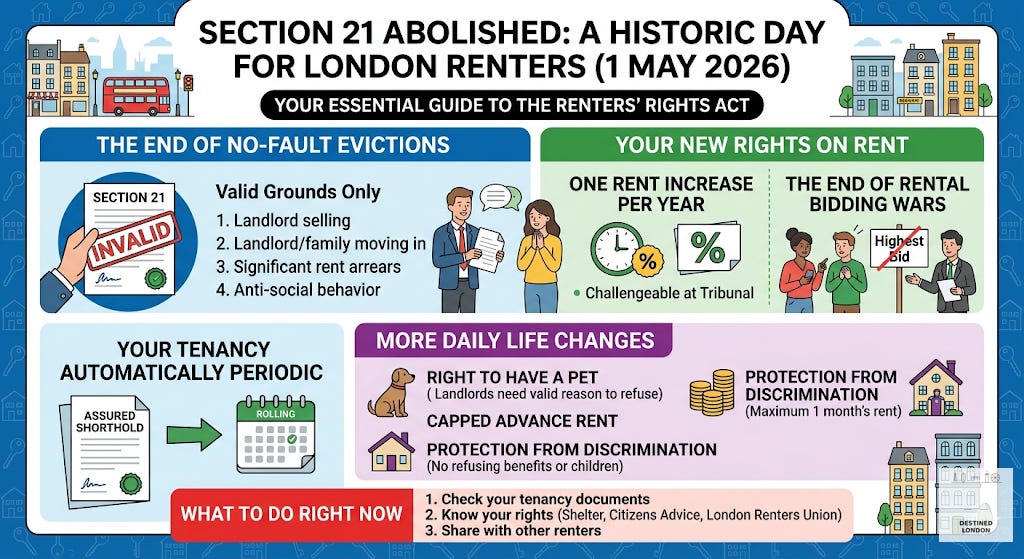
Today is a historic day for anyone renting in London.
If you’ve ever had a landlord end your tenancy with two months’ notice and no explanation, you’ll know exactly how that felt. Unsettling. Disruptive. Sometimes devastating. Section 21 — the no-fault eviction notice — has defined the precarity of private renting in England for decades. As of today, 1 May 2026, it no longer exists.
The Renters’ Rights Act is now in force across England. For London’s 2.7 million private renters, it represents the biggest shift in tenant protections in a generation. Whether you’re a long-term resident worried about rent rises, a newcomer just moving to the city, or someone who has faced housing insecurity before, this is the guide you need. Here’s what’s changed, what it means for you, and what to do next.
The End of No-Fault Evictions
Section 21 Is Abolished — Effective Today
Section 21 was the clause that allowed landlords to end a tenancy without giving any reason, as long as they gave two months’ notice. Millions of tenants across England have received Section 21 notices — often mid-winter, often after years of reliable tenancy. That clause is now gone.
From 1 May 2026, landlords must have a specific legal ground to evict you. These grounds include genuine reasons such as:
The landlord intends to sell the property.
The landlord or a close family member needs to move in.
Significant and persistent rent arrears.
Serious anti-social behaviour.
A landlord cannot simply decide they no longer want you as a tenant and serve notice.
Your Tenancy Becomes Periodic — Automatically
Under the new Act, all assured shorthold tenancies automatically convert to assured tenancies on a periodic (rolling monthly) basis. This includes existing tenancies. You don’t need to do anything. Even if your contract says “fixed term,” it now rolls monthly from 1 May 2026.
This means you have continuous security unless your landlord can prove one of the legal grounds for eviction. You also retain the right to leave with two months’ written notice — so your flexibility is protected, as well as your security.
Your New Rights on Rent
One Rent Increase Per Year — and You Can Challenge It
Landlords can now only raise your rent once every 12 months. They must give you at least two months’ written notice of any proposed increase, served through a specific Section 13 notice form.
If you believe the proposed increase is above the true market rate for your property, you can challenge it at the First-tier Tribunal. The Tribunal will assess what the market rent should be and set the figure accordingly. Critically, the Tribunal cannot set a rent higher than what your landlord originally proposed — and the increase cannot be backdated before the hearing date. In plain terms: challenging an increase costs you nothing and you cannot end up paying more than your landlord originally asked for.
The End of Rental Bidding Wars
This was a particular problem in London. In recent years, some landlords and agents were inviting tenants to submit competing offers above the advertised price. The Renters’ Rights Act bans this. Landlords must advertise at a fixed price and accept no more than that. Asking tenants to bid against each other is now illegal.
More Changes That Affect Your Daily Life
Your Right to Have a Pet
Renters can now formally request to keep a pet. Landlords must consider your request seriously and can only refuse if they have a genuine good reason — for example, a leasehold that prohibits pets in the building. They have four weeks to respond in writing. Blanket “no pets” clauses in tenancy agreements are no longer enforceable.
Deposits and Advance Rent
The maximum amount a landlord can request in advance rent is now capped at one month. Previously, some London landlords — particularly for international renters or those without UK credit history — were requesting six or even twelve months upfront. That practice is now prohibited.
Deposit protection rules remain in place — your deposit must be held in a government-approved scheme. Keep a record of which scheme your landlord is using.
Protection from Discrimination
Landlords can no longer refuse to rent to someone because they have children, or because they receive housing benefit or other government support. These protections were already implied under equality law, but the Act makes the prohibition explicit and enforceable.
What This Means for London’s Rental Market
Small Landlords Are Leaving — and That Has Consequences
The Renters’ Rights Act is prompting a significant exit from the market by small private landlords — those with one or two properties who feel the new regulatory requirements are too burdensome. This is already visible in London’s rental listings, where the proportion of properties available to rent has shifted towards larger professional landlords and Build-to-Rent operators.
In the short term, this may tighten supply in some neighbourhoods. Rents in London were up roughly 1–2% year-on-year as of early 2026, with demand still outpacing supply. The shift to professional operators should, over time, mean more consistent management standards — but it may also mean less availability of the kind of individual flat above a shop that has always been part of London’s rental fabric.
A Landlord Ombudsman Is Coming
A new independent Private Landlord Ombudsman is being established as part of the Act’s wider framework. This will give tenants a formal, accessible route to complain about their landlord’s conduct — without needing to go to court. The Ombudsman service is expected to be fully operational later in 2026.
What You Should Do Right Now
Check Your Tenancy Documents
Your tenancy has already converted to a periodic assured tenancy, but it’s worth reading through your agreement to note what it says. Keep a copy in a safe place — along with your deposit protection certificate, your landlord’s full name and address, and any correspondence about past rent increases.
Know Your Rights Before You Need Them
If you receive a rent increase notice, don’t simply accept it. Research what comparable properties in your area are currently renting for. If the proposed increase feels above market rate, contact Shelter, Citizens Advice, or a London Renters Union adviser before deciding whether to challenge.
The key message from today: you have more security than you have ever had as a private tenant in London. Use it.
Today marks a genuine turning point for renters in London. The precarity that defined private renting in England — the constant background anxiety of a Section 21 notice, the pressure of bidding wars, the powerlessness over arbitrary rent rises — has meaningfully reduced.
The Renters’ Rights Act won’t solve London’s housing crisis. Supply is still constrained, rents are still high, and not everything changes overnight. But the balance of power between tenants and landlords has shifted today in a way that is real, meaningful, and overdue.
Know your rights. Use them. And share this with every renter you know.
FAQs
Does the Renters’ Rights Act apply to my existing tenancy?
Yes. All private tenancies in England automatically convert to assured periodic (rolling monthly) tenancies from 1 May 2026. You don’t need to do anything or sign a new contract.
Can my landlord still evict me?
Yes, but only on specific legal grounds. These include selling the property, moving in themselves or a family member, persistent serious rent arrears, or anti-social behaviour. A landlord cannot simply decide they want you to leave without a valid reason.
What if I receive a Section 21 notice?
Section 21 no longer exists from 1 May 2026. Any Section 21 notice served today or after is invalid. Contact Shelter or Citizens Advice immediately if you receive one.
Can my landlord ask for six months’ rent in advance?
No. The maximum upfront rent a landlord can request is one month’s rent in advance.
I have a pet. Does this law help me?
Yes. You can formally request to keep a pet and your landlord must consider it seriously. They can only refuse with a genuine good reason and must respond in writing within four weeks.
My landlord refused to rent to me because I receive housing benefits. Is that legal?
No. Discriminating against tenants because they receive benefits or have children is explicitly prohibited under the Renters’ Rights Act.
What is the Private Landlord Ombudsman?
A new independent body is being established to handle complaints about private landlord conduct. It will give tenants a formal, accessible way to resolve disputes without going to court. It is expected to launch later in 2026.
Where can I get advice about my rights as a London renter?
Shelter England (shelter.org.uk) has excellent, free, up-to-date guidance specifically on the Renters’ Rights Act. Citizens Advice and the London Renters Union are also valuable resources.
How do I challenge a rent increase?
Apply to the First-tier Tribunal. The Tribunal will set the market rent. They cannot set a higher figure than your landlord proposed, and the increase cannot be backdated.
How much notice does my landlord need to give before raising my rent?
At least two months’ written notice using a Section 13 notice form, and only once in any 12-month period.