
Every spring, certain London spots go briefly, spectacularly viral. The photographs look impossibly beautiful. The reality is that they genuinely are that beautiful — and most of them are entirely free. The catch is timing: the windows are short, sometimes only a week or two, and the crowds build quickly once the first photos appear.
Here’s my guide to the best free spring spectacles in London, with honest notes on when to go.
The Isabella Plantation Bluebells and Azaleas, Richmond Park
The Isabella Plantation is a 40-acre woodland garden within Richmond Park, planted with one of the finest collections of azaleas and rhododendrons in Europe. From late April through mid-May, the colour is extraordinary — deep purples, pinks, oranges, and reds against the backdrop of ancient oaks.
The adjacent woodland also has a strong bluebell display in late April. Richmond Park itself is free; the plantation is within the park and free to enter.
When to go: Last week of April through the second week of May for peak azaleas. Weekday mornings before 10am.
The Wisteria Houses of Kensington and Chelsea
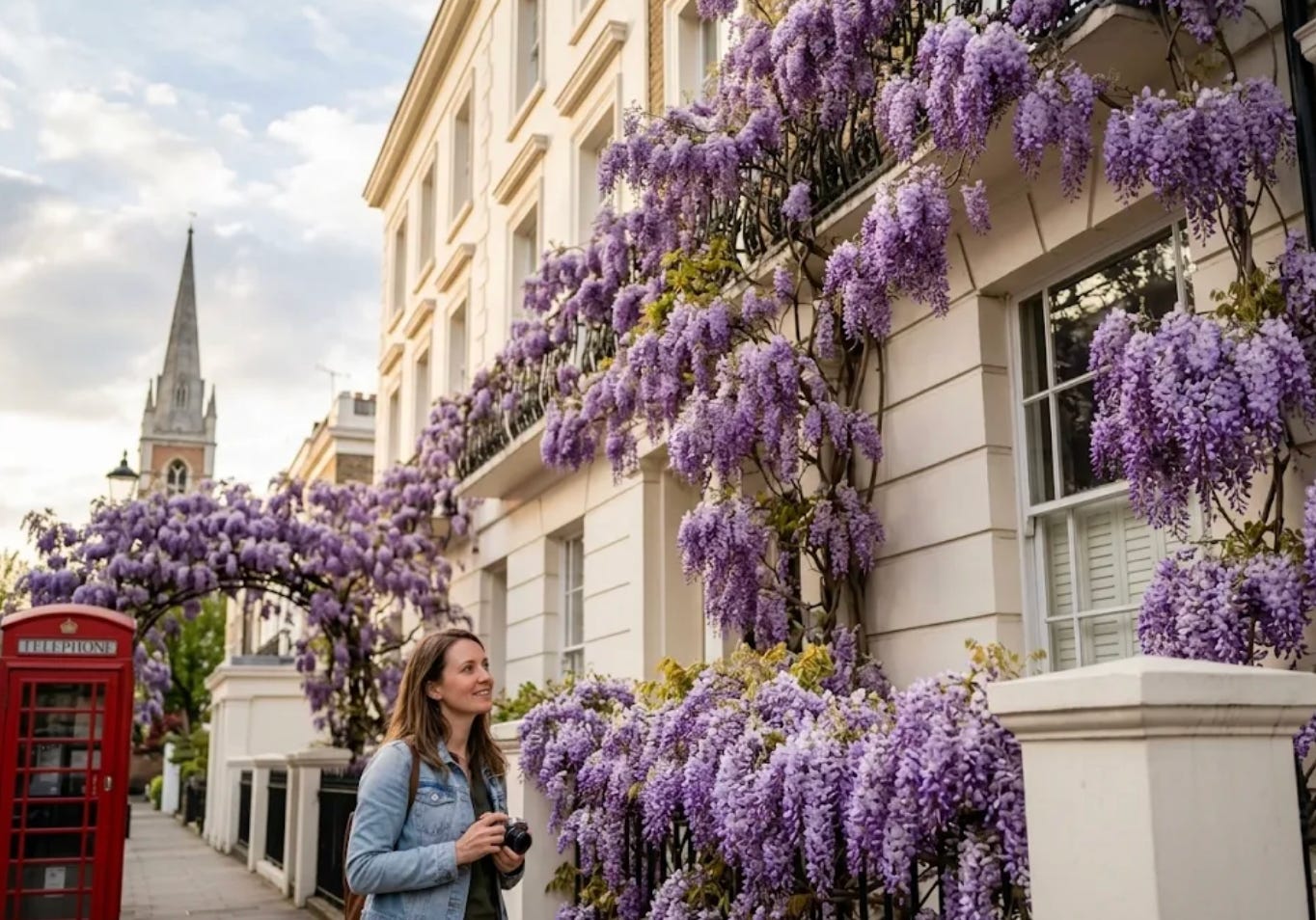
In May, certain streets in Kensington and Chelsea become something close to embarrassingly beautiful. Wisteria grows across the Victorian and Edwardian facades, cascading purple and white from window to window and draping over doorways. It’s free to walk past.
The most photographed wisteria in London is on Gordon Place in Kensington, but the surrounding streets — Eldon Road, Victoria Grove, Holland Street — are equally spectacular and somewhat quieter. The wisteria season is short: usually the first two weeks of May.
When to go: Early May. A warm spring will bring it out earlier.
The Magnolia Trees of South Kensington
The streets around South Kensington tube station — particularly Onslow Square, Pelham Crescent, and the roads behind the museums — are lined with large, mature magnolia trees that bloom in late March and early April before the leaves appear. The flowers are large, white and pink, and the effect against the white stucco of the houses is extraordinary.
Free to walk. Best on a still morning before the wind takes the blooms.
When to go: Late March to mid-April depending on the year.
The Bluebell Woods of Hainault Forest, East London
Hainault Forest in east London (Zone 4, about 40 minutes from central London) has one of the most extensive bluebell displays of any woodland accessible by tube. The carpet of blue in late April and early May is the kind of thing that makes you feel like you’ve accidentally walked into a painting. Free. Far less crowded than the well-known bluebell sites.
When to go: Late April to first week of May. The Central line to Hainault takes about 40 minutes from Bank.
The Cherry Tunnel, Battersea Park
The ornamental cherry avenue along the Thames-side path in Battersea Park forms a brief pink tunnel when the blossom is at peak. It’s one of the most photographed spring sights in London and genuinely delivers on the photographs. Free.
When to go: First two weeks of April. Arrive before 9am at weekends to avoid the crowds that gather once the Instagram photos start circulating.
The Canal Banks in Spring
Less celebrated but genuinely lovely: the canal towpaths in spring — Regent’s Canal from Angel to Broadway Market, the Grand Union Canal around Little Venice — are lined with flowering trees and canal-side gardens. The combination of water, blossom, and houseboats makes for excellent walking.
Free, accessible, and at their best in April.
FAQs
1. When is spring in London?
Meteorologically, March through May. In practice for blossom and flowers, late March to mid-May is the active window.
2. How do I find out when specific flowers are at their best?
Kew Gardens publishes seasonal bloom updates. The National Trust also provides forecasts for gardens on its properties. For street blossom, there’s no official source — follow London-based plant accounts on Instagram for real-time updates.
3. Are the bluebell woods in London worth visiting?
In my experience, yes — particularly Hainault Forest and the Isabella Plantation, which are more accessible and less crowded than the famous bluebell woods in Surrey or Kent.
4. Can I visit the Wisteria houses without going into someone’s property?
All the wisteria I’m describing grows on the exterior of private houses but is visible and photographable from the public pavement. You’re not entering private property.
5. Is it crowded at these spring spots?
At peak bloom on a sunny weekend, yes — some significantly so. Early weekday mornings are dramatically quieter. The Isabella Plantation and Hainault Forest are consistently calmer than Battersea Park or the Kensington streets.
6. What’s the best London spring walk?
In my opinion: the canal from Angel to Broadway Market in April, timed to coincide with the market on a Saturday morning, is one of the finest spring mornings London offers.
7. Are there good spring gardens beyond the ones on this list?
Kew Gardens (paid), Osterley Park (National Trust), and Chelsea Physic Garden are all excellent for spring flowers. The Barbican conservatory (free on some weekends) has tropical spring plants year-round.
8. What’s the best spring flower in London?
Personally: the magnolias on the South Kensington streets in late March, against the white stucco houses in early morning light.
9. Is wisteria the same every year?
Approximately, but the timing varies by a week or two. A warm spring can bring it out in late April; a cold spring may delay it into May.
10. Where should I go if I miss the blossom season?
Late May through June has rose season at Regent’s Park and various walled gardens. Summer brings the lavender fields in Surrey (accessible by train). London has something in bloom in every month of the year.
— A note from the editor
Destined for London shares my personal experiences, opinions, and independent research. Everything I write reflects what I’ve found to be true at the time of publishing — but London changes constantly, and what works for me may not work for you. Always do your own research and seek qualified professional advice before making decisions about property, finance, schools, healthcare, or anything else that matters. Some links in my posts are affiliate links, meaning I may earn a small commission at no extra cost to you. Sponsored content is always clearly labelled. Read the full Terms and Privacy Policy.