
Your Bus Is Negotiating With Traffic Lights (Yes, Really)
Part 3 of 4: The Hidden Tech Running London's Buses

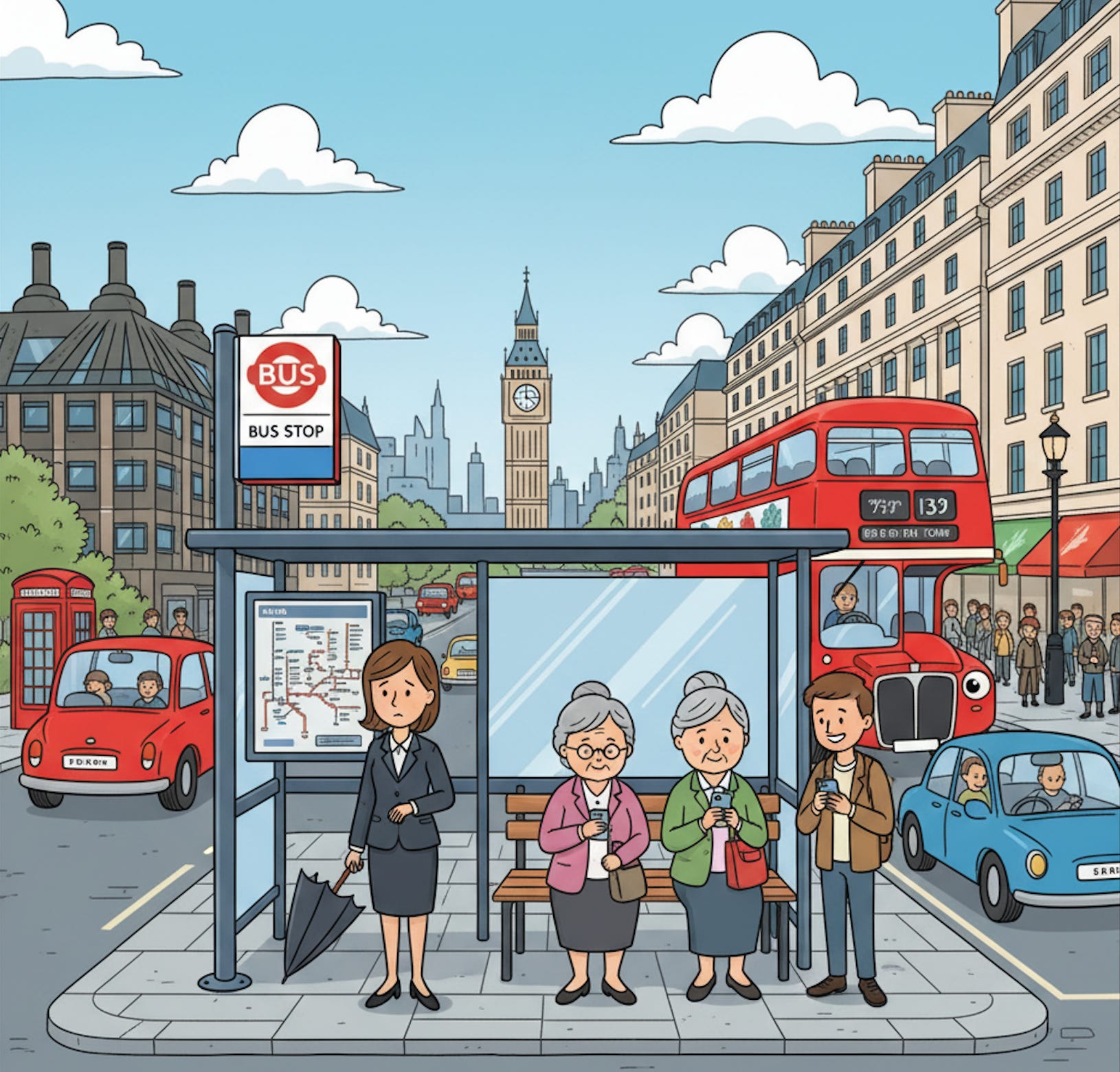
We need to talk about one of the most maddening experiences in urban transport.
You’re on a bus. It’s moving along nicely in a dedicated bus lane—a lane that exists solely for buses, completely empty of other traffic. And then you stop. You stop at a red light. You sit there, watching cars flow through the junction in their lanes, whilst your bus -in its own special lane waits. And waits. And waits.
It feels deeply, viscerally unfair.
Buses are public transport. They’re carrying 40, 50, sometimes 80 people. They’re the efficient option, the green option, the option that should be prioritised. And yet here you are, stuck at a light that’s prioritising eight people in their individual cars over the 60 people on your bus.
London noticed this too. And in the mid-2000s, they decided to do something genuinely clever about it.
The Selective Vehicle Detection System
Here’s the science fiction bit: buses in London can ask traffic lights to change.
Well, not exactly “ask” in the way you might ask someone to pass the salt. It’s more like a quiet negotiation, a constant conversation between the bus and the infrastructure around it.
The system is called Selective Vehicle Detection, and here’s how it works:
Buses are equipped with short-range transmitters—think of them as a friendly radio signal that broadcasts “Hello, I’m a bus, I’m approaching.” Traffic lights are fitted with corresponding receivers that can detect this signal.
When a traffic light’s receiver picks up an approaching bus, the traffic signal system makes a calculation. It looks at the current cycle, the traffic flow, the time of day, and asks itself: “Can I help this bus without completely messing up everything else?”
If the answer is yes, it adjusts. It might extend a green light by a few seconds so the bus can make it through. It might shorten a red phase to let the bus through sooner. It might speed up or slow down the whole signal cycle to give the bus priority.
The light doesn’t always change—that would cause chaos. But when it can help without disrupting the overall traffic flow, it does.
According to Transport for London, when you combine this system with dedicated bus lanes and proper enforcement, journey times can improve by up to 15%.
Fifteen per cent might not sound revolutionary, but when you’re talking about 9,000 buses making millions of journeys, it adds up to something substantial. It’s the difference between a 40-minute journey and a 34-minute journey. Multiplied across an entire network, it’s thousands of hours saved every single day.
The Three-Part Brain
But let’s rewind a bit, because the story of how buses got smart enough to negotiate with traffic lights starts with a bigger leap: the introduction of the iBus system in the mid-2000s.
The old lamppost checkpoint system we talked about last week had a fundamental limitation: it only knew where a bus had been, not where it was. The iBus system changed everything by tracking buses continuously, in real-time.
The clever bit? It doesn’t rely on just one technology. It uses three, working together like a three-part brain.
First, there’s GPS. This gives you the satellite-based location data—latitude and longitude, the basic “where am I in the world” information.
Second, there’s an odometer. This measures exactly how far the bus has travelled by counting the rotations of the wheels. Every time the wheels go round and round (yes, like the song), the odometer records the distance.
Third, there’s a gyroscope. This tracks the direction the bus is travelling, noting every turn, every change in orientation.
Why Three Systems Are Better Than One
You might be wondering: isn’t GPS enough? It works for your phone, doesn’t it?
Well, yes and no. GPS is brilliant for showing you where you are on a map when you’re walking around with a clear view of the sky. But in central London, GPS has a problem.
Buildings. Tall ones.
When you’re navigating the streets around the City, or threading through the narrow roads of Westminster, or passing through areas with dense high-rises, GPS signals can bounce off buildings, or get blocked entirely. This creates what engineers charmingly call “urban canyons” places where satellite signals struggle to reach.
If you relied purely on GPS, your bus might think it’s halfway down a side street when it’s actually on the main road. Or it might briefly lose signal and have no idea where it is at all.
But by combining GPS with the odometer and gyroscope data, the system can calculate position far more accurately. If GPS says you’re at one location, but the odometer says you’ve travelled another 200 metres and the gyroscope says you’ve turned left, the system can work out where you actually are—even when the GPS signal is weak or confused.
It’s like having three witnesses to an event. Any one of them might be slightly mistaken, but together, they can piece together what really happened.
From Passenger Tool to Network Management
Here’s where the system gets genuinely sophisticated.
The original lamppost Countdown system was essentially a passenger information tool. It told you when your bus might arrive. That’s it.
iBus transformed tracking from a passive information system into an active network management tool.
For the first time, Transport for London controllers could see every single bus in the network on a screen, in real-time. They could see which routes were running smoothly and which ones were bunching up—that annoying phenomenon where three buses arrive at once, followed by a 20-minute gap.
And crucially, they could do something about it.
Controllers could radio individual drivers with instructions: “You’re running three minutes ahead of schedule, please hold at the next timing point.” Or: “There’s a gap behind you, please speed up if you can safely do so.”
This is why bus bunching, whilst still annoying when it happens, is far less common than it used to be. The system can spot it developing and intervene before three buses end up in a convoy.
The Automated Announcements
There’s another benefit you probably use without thinking about it: the automated stop announcements onboard buses.
“The next stop is Oxford Circus.”
That’s the same iBus system working in the background. It knows exactly where the bus is, which route it’s following, and which stop is coming up next. It’s not just helpful for passengers who are unfamiliar with the route—it’s essential for visually impaired passengers who might not be able to see out of the windows or read the stop names.
And because it’s all automated and precise, drivers don’t have to remember to announce stops or worry about missing one during a busy shift.
The Negotiation Network
Coming back to those traffic lights, what’s fascinating is how this all connects together.
The bus knows where it is (thanks to GPS, odometer, and gyroscope). It knows where it’s going (because it’s following a route loaded into the system). And it’s constantly broadcasting its presence to the infrastructure around it.
Traffic lights receive that information and make split-second decisions about whether they can help. Bus lane cameras are watching to make sure no one blocks the bus’s path. Controllers in the control centre can see if a bus is falling behind and understand why.
It’s not just a bus on a road any more. It’s part of a network, in constant communication with the city around it, optimising in real-time.
The Human Element
There’s something quite profound about all this technology being deployed to solve a very simple, very human problem: making your journey less annoying.
No one boards a bus thinking “I hope I experience optimal network management today.” They’re thinking “I hope this doesn’t take too long” or “I hope I’m not late for work.”
All of this infrastructure—the transmitters, the receivers, the three-part positioning system, the traffic light negotiations—exists to save you a few minutes. To make your journey a bit more predictable. To reduce the frustration of sitting at a pointless red light.
It’s engineering in service of everyday life, which is rather lovely when you think about it.
What’s Coming Next
But if you think real-time tracking and traffic light negotiation is impressive, wait until you see what’s happening now.
London has just rolled out a £160 million upgrade to the entire system. It’s called iBus 2, and it does something the previous systems couldn’t: it learns.
It doesn’t just track where buses are—it predicts where they’ll be, based on what’s happening further up the route. It’s looking ahead, understanding traffic patterns, and adjusting predictions before delays even happen.
Next week, we’ll explore how London’s buses learned to see the future.
Part 1: Your Bus Stop Is Lying to You (But in a Good Way)
Part 2: When Buses Talked to Lampposts: London’s Pre-GPS Miracle
Next week: “The £160 Million Upgrade That Sees the Future”
Have you noticed buses seeming to breeze through traffic lights whilst other vehicles wait? Did you know this system existed?