

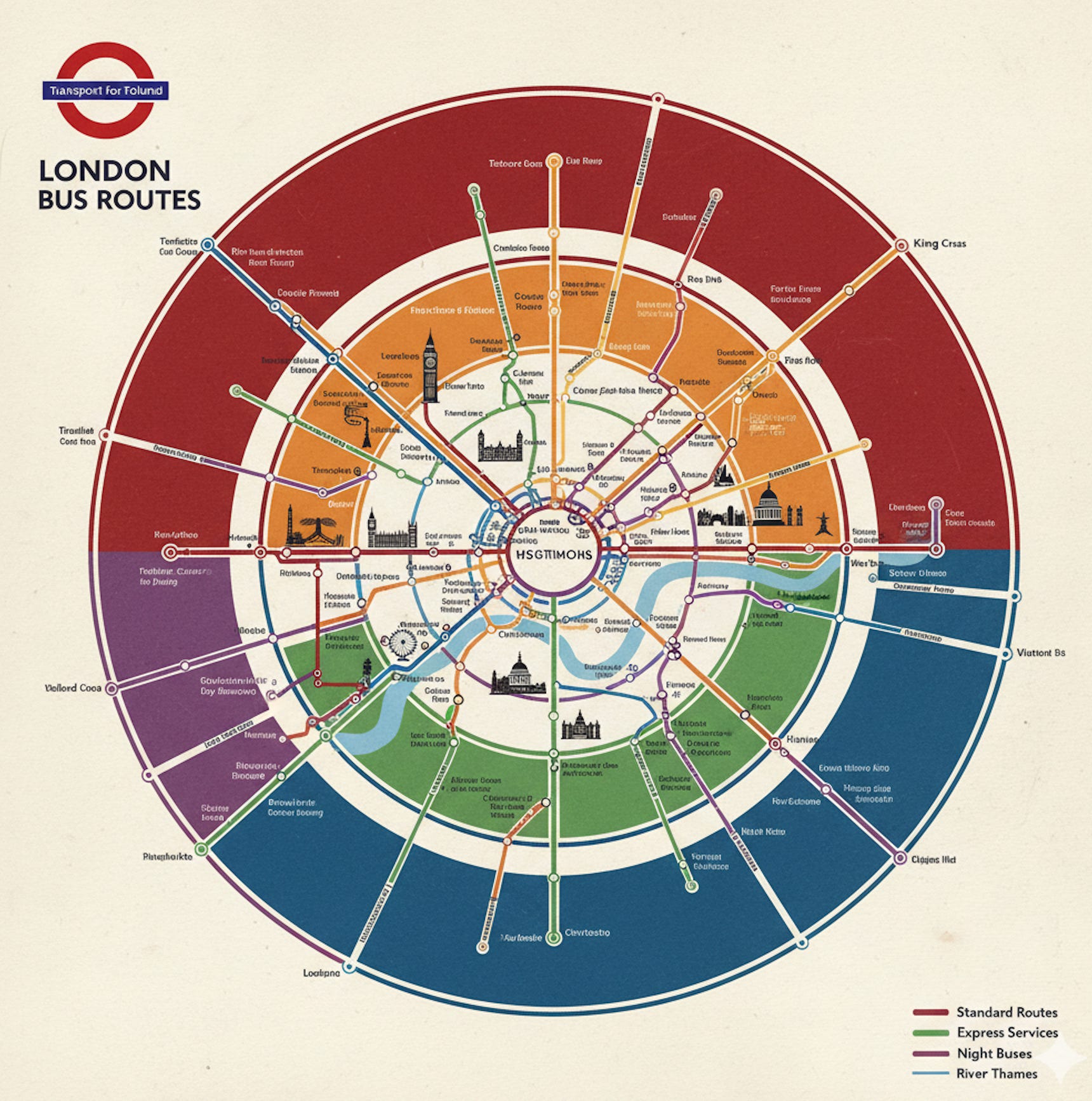
Every morning, somewhere in London, someone is standing at a bus stop, staring at a screen.
“Bus arriving in 3 minutes.”
They trust this prediction implicitly. They’ve timed their entire morning around it. The coffee, the last scroll through emails, the final goodbye to the cat. Three minutes means three minutes, and in a city that moves 8.9 million people every day, that kind of precision feels like a small miracle. Here’s the thing: that countdown isn’t quite telling you the whole truth.
Don’t get me wrong, it’s not lying in the way your mate does when they text “5 mins away” whilst still in their pyjamas. It’s doing something far more sophisticated. That number on the screen is the product of one of the world’s most complex urban tracking systems, a layered technological marvel that’s been evolving for over three decades.
The Scale of the Problem
Let’s talk numbers for a moment, because the logistics are genuinely staggering.
London operates around 9,000 buses. These aren’t running on fixed tracks or following a rigid, unchangeable path like the Underground. They’re navigating the messy reality of city streets, traffic jams, roadworks, that one taxi that’s decided to park in the bus lane, the tourist who’s stepped out without looking.
These 9,000 buses serve 19,000 bus stops. Think about that. Nineteen thousand distinct locations, each one a unique point on the map that the system needs to recognise, understand, and account for.
And together, they complete nearly two billion passenger journeys every single year.
Two. Billion. That’s roughly 5.5 million journeys every single day. Each one of those journeys relies on the same question being answered accurately: “Where is my bus?”
Why Buses Are Harder Than Trains
If you’ve ever wondered why the Tube feels more predictable than buses, there’s a simple reason: trains run on rails. The track network is fixed. A Northern Line train heading to Morden has exactly one path it can take. There are signals, there are schedules, and whilst delays happen, the fundamental route never changes.
Buses? Buses are navigating what’s essentially a moving puzzle.
A bus route might be diverted because of roadworks on the high street. A parade might close an entire road for the afternoon. Traffic might be flowing smoothly at 11am and grinding to a halt by 4pm. Every single journey is subject to hundreds of variables that don’t exist in a closed system like the Underground.
And yet, somehow, when you check that countdown screen, it knows. It knows your bus is three minutes away. Then two. Then one. Then due.
How?
It’s Not One System. It’s an Evolution.
Here’s where it gets interesting.
The live countdown screen you glance at whilst deciding whether you have time to nip into Pret isn’t powered by a single piece of clever technology. It’s the tip of an iceberg -the visible output of decades of innovation, bodge jobs, foundational infrastructure projects, and genuinely brilliant problem-solving.
The system that tracks London’s buses today is built on layers. Some of those layers are cutting-edge, using AI and predictive algorithms. Others are surprisingly old-fashioned, relying on infrastructure that was installed when John Major was Prime Minister and “Rhythm Is a Dancer” was topping the charts.
And the fascinating thing? Each layer solved a specific problem at a specific time, and together they’ve created something that works remarkably well.
The Small Miracle You Take for Granted
Think about what that countdown represents for a moment.
Somewhere in London, right now, a control centre knows the location of every single one of those 9,000 buses. It knows which route they’re on, which direction they’re heading, and how fast they’re moving. It’s calculating their arrival times based not just on distance, but on current traffic conditions, typical patterns for that time of day, and real-time updates from the road.
And it’s doing this continuously, for every bus, updating the prediction every few seconds, and broadcasting that information to 19,000 bus stops and millions of smartphones.
That’s not just impressive. That’s the kind of logistical coordination that would have seemed like science fiction a few decades ago.
The Trust We Place in a Number
There’s something quite profound about how much faith we place in that countdown.
We’ve all experienced the betrayal when a bus that was “due” suddenly vanishes from the screen entirely, presumably having been swallowed by a pothole or decided to retire early. We’ve felt the quiet rage when the timer seems to freeze, stuck on “2 mins” for what feels like an eternity.
But mostly? Mostly it works. Mostly you trust it, and mostly it’s right.
That trust is earned through the invisible infrastructure that makes it all possible. And that infrastructure has a story—one that starts in a surprisingly analogue place.
What’s Coming Next
Over the next few weeks, I’m going to take you behind that countdown screen and show you the hidden systems that make London’s buses trackable.
We’ll start in 1992, in a world before civilian GPS, before smartphones, before most people had even heard of the internet. London launched its first bus tracking system that year, and the solution they came up with was brilliantly weird.
It involved lampposts.
Yes, really.
Next week: “When Buses Talked to Lampposts: London’s Pre-GPS Miracle”
Have you ever watched a countdown freeze or a bus mysteriously disappear from the screen? What’s the longest you’ve trusted a lying countdown? Hit reply -I’d love to hear your bus stop horror stories.